


 Whitman Expo
1796 Coin in Post-ANA Auction Rarities Session
On September 1, Stack’s Bowers conducted a Rarities Night session in California as part of this firm’s post-ANA World’s Fair of Money® auction extravaganza.
by Greg Reynolds |
Published on November 9, 2026

Download the Greysheet app for access to pricing, news, events and your subscriptions.
Subscribe to Greysheet for the industry's most respected pricing and to read more articles just like this.
As it is not practical to cover all of the more than 600 coins in this one session, and little is gained by listing prices realized, the focus here is on three extremely important coins, all from the year 1796. These coins have educational value to those interested in the history of U.S. coinage and the culture of coin collecting, not just to collectors who can afford them.
The rarest silver type coins are 1796 quarters and 1796-97 half dollars, all of the Draped Bust, Small Eagle design. Although 1796-97 half dollars are rarer, 1796 was the first year of the quarter denomination and 1796 quarters are one-year type coins. Quarters were not minted again until 1804, with the Heraldic Eagle reverse replacing the Small Eagle reverse design.
Both the originality and the certification of the 1796 quarter in this Rarities Night session distinguish it from other 1796 quarters. As so many pre-1840 silver coins have been dipped in acidic solutions, chemically altered, heavily brushed, deliberately smoothed, or subject to additives, the originality of this 1796 quarter is refreshing.
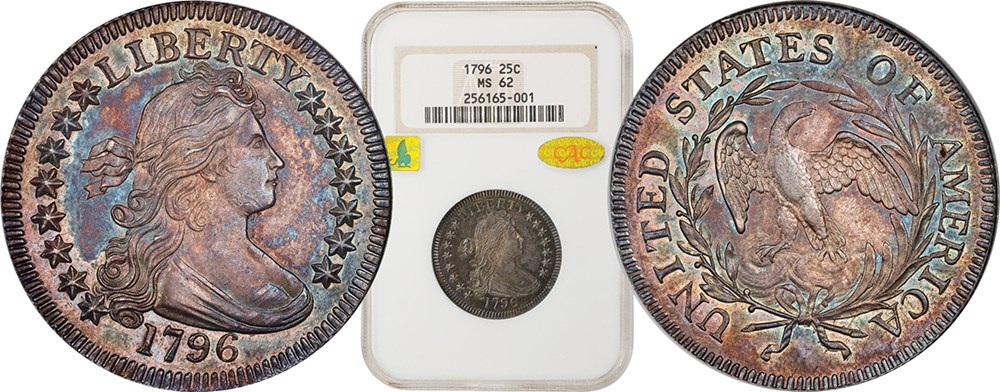
This 1796 quarter was NGC graded MS62 on September 13, 1993, according to the NGC website. It now has a gold sticker from Certified Acceptance Corporation (CAC), which means that experts at the CAC office in New Jersey determined that it was clearly undergraded in the context of CAC standards. In some cases, a certified MS62 grade coin that receives a gold sticker likely receives an MS63+ or MS64 grade later. Rather than seek an upgrade, it would be better for the coin community if a sophisticated collector bought this 1796 quarter and keeps it in its 33-year-old holder, with the CAC gold sticker. This is a historical artifact that should be left alone.
The colors are the same or very much like those that I have seen on other 1796 quarters: brown-russet, deep-russet, medium to dark green, blue-green blends, peach, etc. The balance and mixes of colors on this coin, however, are exceptional.
The technical imperfections are minor and are consistent with a grade that is higher than 62. There are small contact marks on Miss Liberty’s face, chin, neck, and nearby field. Some hairlines are in this region, too, though not many. There is a small awkward area near star #2 and star #3, though it is not consequential.
While I am aware that others might find this coin to be too dark for a 63+ or 64 grade, originality and deep rich colors very much appeal to me. The grade of the reverse is higher than the grade of the obverse. I count the grade of the obverse as two-thirds of the overall grade, and the reverse as one-third, so a superior reverse can push the overall grade upward, from my perspective.
As for how this coin will be certified in the future, I decline to comment. A business reality is that grading wholesalers may submit the same coin to multiple services or multiple times to the same grading service. An attempt to lighten this coin would be harmful yet may occur anyway.
Before the auction, Greysheet-CAC (green sticker) Bid for an MS62 grade 1796 quarter was $190,000, and Greysheet-CAC Bid for an MS63 grade 1796 quarter was $250,000. The CPG-CAC medium retail value estimate for an MS63 grade 1796 quarter was $300,000, which was more than non-CAC Greysheet Bid for an MS64 grade 1796 quarter, $260,000. In October 2025, Heritage sold a CAC-stickered, NGC graded MS64 1796 quarter for $408,000, which was a mid-retail price.
For this coin, I figured that a price around the wholesale/retail border would be $260,000. I am or was almost certain that at least a couple dealers would be willing to pay $260,000 for this coin. The $292,800 result was certainly a retail price, though not a high-retail price, really a fair collector price for a CAC gold-stickered "MS62" grade 1796 quarter. This result could also be interpreted as a low-wholesale price for a non-CAC, MS64 grade 1796 quarter, given that it is not known whether it will ever be certified as grading MS64. In my personal opinion, this coin grades MS63+, and I find the price realized to be consistent with my grade.
While 1796 quarters are very rare in high grades, both 15-star and 16-star 1796 half dollars are very rare in all grades. The layout of 15 stars refers to 15 states. Tennessee became the 16th state of the U.S. on June 1, 1796.
The exemplary 1796 halves in the September 1 sale were formerly in the Eric Newman Collection. Heritage had auctioned many of Eric Newman’s high-quality U.S. silver coins on November 15, 2013.
The Newman 1796 15-star obverse half was NGC graded MS62 and Newman’s 1796 16-star obverse half dollar was NGC graded MS63, with a CAC sticker. For reasons unknown to me, the latter was in a relatively new NGC holder in 2026, while the MS62 grade 15-star 1796 was in its original NGC holder from 2013, with a logo relating to Eric Newman.
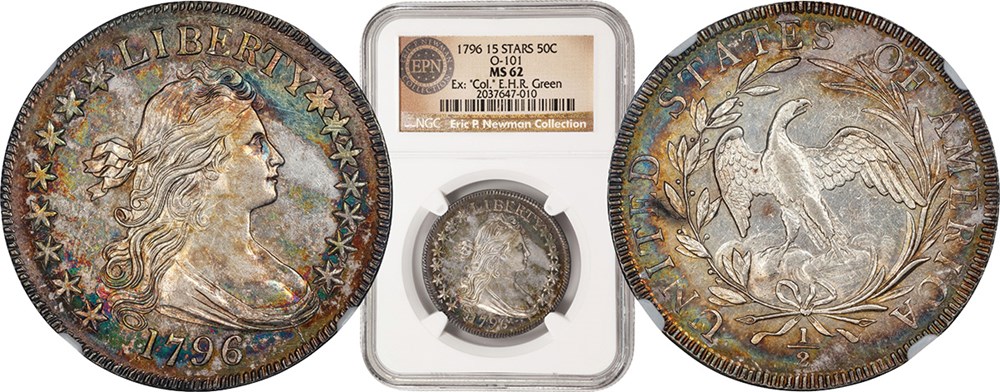
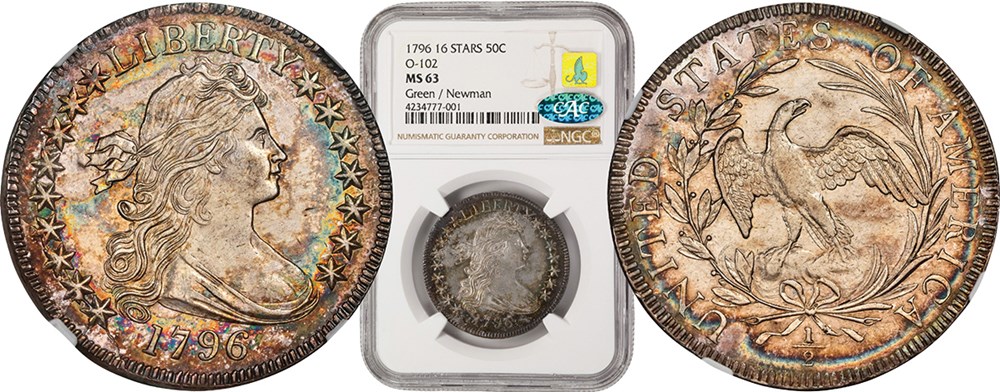
Both coins recovered impressively from past dippings and exhibit colorful natural toning. On both, there are many light hairlines from a brushing with some kind of liquid. There are no deep gashes or worrisome hits.
Most of Newman’s pre-1840 silver coins were earlier owned by Col. E. H. R. Green, another famous collector. It is a coincidence that someone named Green formerly owned many coins that now feature attractive green toning.
The colors are extremely likely to stem from Wayte Raymond "National" coin boards or albums, which were very popular among collectors in the middle of the 20th century, including Newman. There are multiple shades of green on both coins, along with much gray. Moreover, touches of magenta on the obverses of both coins should be noted. The MS63 grade 1796 half has more yellow and blue toning on the obverse than the MS62 grade 1796 half, which features a nice brown-russet hue, along with gray, orange-russet and shades of green.
The colors on the Newman-Green, CAC approved, NGC graded MS63 1796 16-star half are especially entertaining. The brown-russet outer fields and the green-blue areas just inside the stars are really cool. Some stars are reddish while others are orange-russet, gray or green. Several pretty tones formed about the letters of LIBERTY, including red, orange-russet, yellow and green. There is also much mottled orange-russet toning in different areas of the obverse.
The reverse is characterized by gray and mottled green-russet toning. Blue-gray areas are pleasant.
The reverse is almost fully prooflike. The obverse is somewhat prooflike. If not for a light to moderate cleaning, this coin would merit a higher grade.
On November 15, 2013, this 16-star 1796 half realized $470,000. This time, it brought $671,000, 42.8% more. The Newman NGC-graded MS62 15-star half had previously realized $282,000. On September 1, 2026, the same coin brought $317,200, an increase of 12.5%.
Stack’s Bowers had auctioned a PCGS graded MS62+ 1796 15-star half on August 17, 2021. Before November 1988, that coin was in the Norweb Family Collection. The Newman, NGC graded MS62 15-star 1796 half is vastly superior to that Norweb coin, which realized $312,000 in 2021.
As for the value of the CAC approved, NGC graded MS63 Newman half, the $671,000 result on September 1, 2026, was very strong. Greysheet-CAC Bid for an MS63 grade 1796 half increased from $310,000 to $360,000 in mid-2022 and then was raised to $384,000 in February 2023. It remained $384,000 until it was raised to $520,000 in October 2025 and then it was raised to $650,000 after this auction.
It is unlikely that the current $671,000 result is close to a wholesale level, as the Greysheet now suggests; I find it to be a middle-to-high retail price.
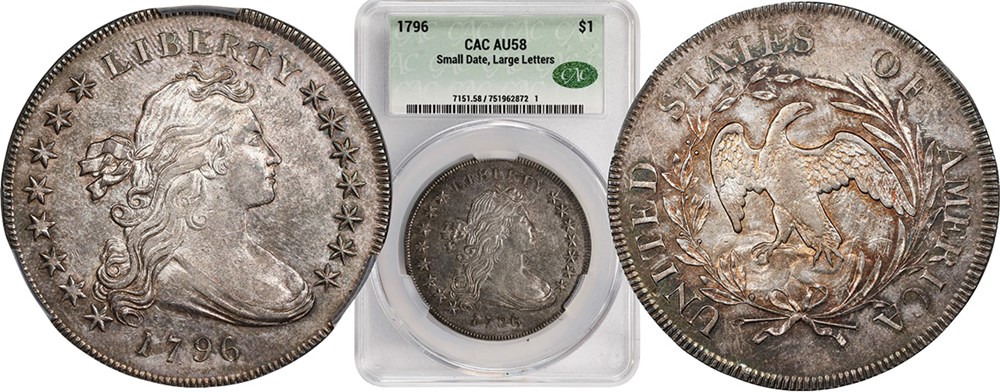
There were additional 1796-dated coins in this Stack’s Bowers session. Although I like the coin, I was startled that a CACG graded AU58 1796 silver dollar brought $122,000, a very strong price. It is the second highest graded 1796 Large Letters dollar in the CAC population report. Collectors building CAC-only sets of bust dollars may have bid aggressively.
It would not be fair to the coins or the buyers to summarize the 1796 copper coins in this sale. They really need to be treated as a separate topic.
On the whole, there was a diverse selection of rarities and much fresh material in this Stack’s Bowers Rarities Session. It was an intriguing and successful auction.
Images courtesy of Stack’s Bowers Galleries (Costa Mesa,CA).

Related Stories (powered by Greysheet News)
View all news
A wide range of U.S. and pioneer gold coins from 1798 to 1933 proved to be highlights of the February 3 Stack's Bowers sale of the second part of the James A. Stack Sr. Collection.

Highlights from the auction were on display at the recent New York International Coin Convention.
Numismatic researcher Greg Reynolds does a deep dive into the Alymaya set of Saint Gaudens double eagles sold by Heritage in August 2025.
Please sign in or register to leave a comment.
Your identity will be restricted to first name/last initial, or a user ID you create.
Comment
Comments