


 Whitman Expo
Denver Mint Silver: Rarities of the 20th Century
On nine occasions in the 20th century, the Denver Mint produced fewer than one million coins in a certain year and denomination.
by Larry Jewett |
Published on October 9, 2026

Download the Greysheet app for access to pricing, news, events and your subscriptions.
Subscribe to Greysheet for the industry's most respected pricing and to read more articles just like this.
Mintage figures are often the first indication to a new collector that a coin needed to complete a collection could be a challenging find. While there may be tens of millions of a particular issue from one mint location, low mintages from the branch mints tend to throw a curveball into the mix.
On nine occasions in the 20th century, the Denver Mint produced fewer than one million coins in a certain year and denomination. Often, it reflected the lowest output of that date and denomination, but occasionally another branch mint produced even lower numbers. Regardless of the production elsewhere, the simple fact that fewer were made can carry a large impact, especially when seeking the finest graded coins.
Denver’s Role
While the Denver Mint did not begin making coins for circulation until 1906, there was a lengthy history prior to this year that bears repeating. The mint in Denver was established by an act of Congress in April 1862 exclusively for the coining of gold. At the time, the nation was embroiled in the Civil War being fought far away from the Colorado territory. Early operations were confined to the melting and assaying of bullion and returning it to the depositors. Coins would be produced elsewhere, such as the Carson City Mint, which was established in 1870, and the San Francisco Mint, which opened in 1854.
Denver would get back to the purpose of making coins with the passing of an act on February 20, 1895 that sought production of gold and silver coinage. Essentially, this was intended to pick up the slack created in part by the closing of the Carson City Mint in 1893. Colorado had become a state in 1876 and Denver was its capital and center of commerce and a key connection to the westward movement of the nation. A site was purchased in 1896, but appropriations to create the proper facility were lacking and it took time for the government to set aside needed funds to move the project forward. Finally, a sale of the previous location provided financial assistance and the move to the new building began in 1904.
In the first year of silver coinage, Denver was responsible for dimes, quarters and half dollars. Among the gold coins issued from the facility in 1906 were 320,000 half eagles, 981,000 eagles and 620,250 double eagles.
Gold coin production never reached the level of silver coins throughout the history of the mint. Only the 1909 Indian Head half eagle, with a mintage of 3,423,500, and a pair of early eagles exceeded the one million mark among gold coin production in the early years. Mass production of double eagles in the early 1920s resulted in more than one million made on three occasions.
As noted, a mintage greater than one million was common for silver coins, but there were times when the production declined. We start with dimes.
Dimes
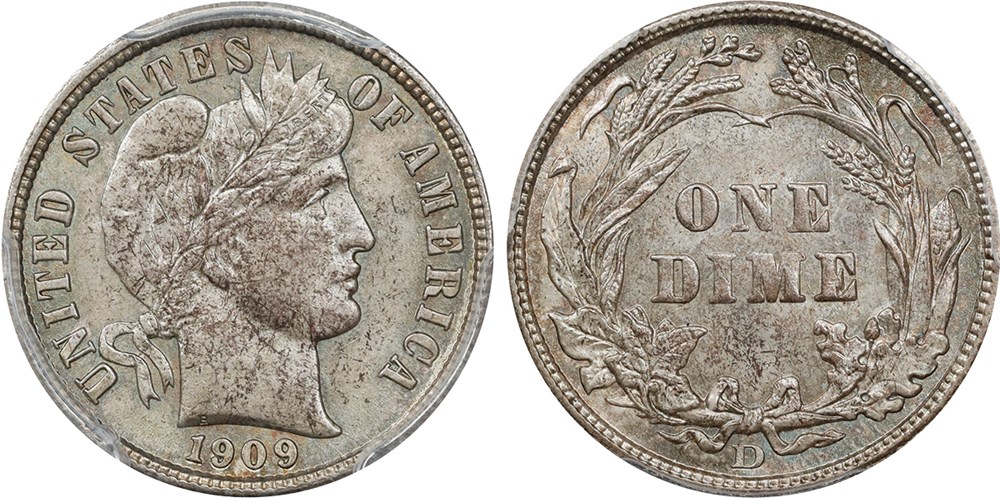
1909-D
- Mintage at Denver – 954,000
- Total mintage (Philadelphia, Denver, New Orleans, San Francisco) – 14,481,000
- Percentage from Denver – 6.5%
Both Denver and San Francisco (1,000,000) were on the low end of production for the 1909 Barber dime. For the last time, four mints contributed to the supply with New Orleans closing later in the year.
Denver had been making dimes with the Barber design since 1906 and had been second to Philadelphia the year before with a production of 7,490,000. Production of dimes in 1909 was reduced at all mints with the exception of New Orleans. Denver’s mintage would not drop below 1,000,000 for the remainder of the Barber dime period, reaching a high of 11,908,000 in 1914.
Stack’s Bowers sold the finest known example (MS67) on the PCGS census for $9,300 in 2019. Heritage Auctions sold an example graded MS66 in 2003 for $14,950.
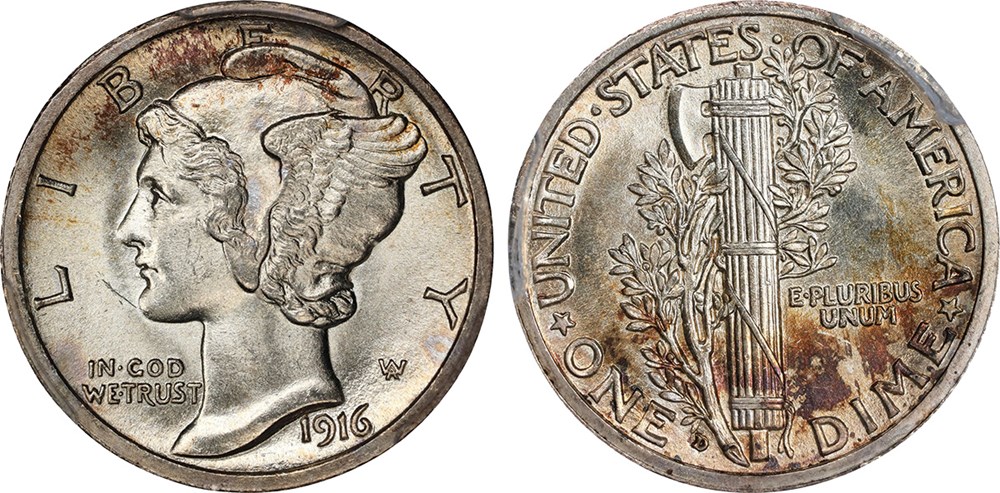
1916-D
- Mintage at Denver – 264,000
- Total mintage (Philadelphia, Denver, San Francisco) – 32,894,080
- Percentage from Denver – .8%
Long recognized as one of the greatest rarities in the Winged Liberty Head series, the 1916 issue from Denver also has the notoriety of being one of the coins most often targeted by counterfeiters.
As noted in 100 Greatest U.S. Coins by Jeff Garrett and Ron Guth, "The true scarcity of the 1916-D Dime has been masked by the presence of numerous fakes, most of which were created with the addition of a small mint mark on the back of a Philadelphia Dime. Certification remains a must to prevent the disappointment of discovering, some years later, that your beloved 1916-D Dime is an impostor!"
David Hall noted on pcgs.com, "The 1916-D is rare in all grades. Walter Breen has written that mint production of dimes in Denver in 1916 was stopped so that personnel could devote full time to making quarters. The original mintage of 264,000 for the 1916-D is by far the lowest of the Mercury dime series."
Numismatists have noted that examples in Mint State are exceedingly rare and that many of the coins were well circulated before it was noted that they had the potential of rarity. Finding an example that qualifies for the Full Bands designation on the reverse becomes even more challenging. This issue is cited as being the main stopper for those interested in gathering a complete set and can be cost-prohibitive, even at a lower grade. The 2027 edition of A Guide Book of United States Coins (Red Book) puts the value of a 1916-D in Very Good 8 at $2,200 and it reaches five figures at AU50.
Quarters
1911-D
- Mintage at Denver – 933,600
- Total mintage (Philadelphia, Denver, San Francisco) – 5,641,600
- Percentage from Denver – 16.5%
When Denver started minting quarters in 1906, the output was nearly equal to that of Philadelphia. Production surpassed Philadelphia in 1908, but ran second to New Orleans. From there it tapered off until dropping below one million units in 1911.
While Denver slipped below the million mark, so too did San Francisco in 1911, with Denver recording its lowest output of Barber quarters. Despite the small mintage, nearly one in six quarters bearing the 1911 date came from Denver.
Three coins have reached MS66 in the PCGS census and one was sold for $10,500 by Stack’s Bowers early in 2025. A few months later, the lone example graded MS66+ brought $16,200 from the Altamura Family Collection by Heritage Auctions.
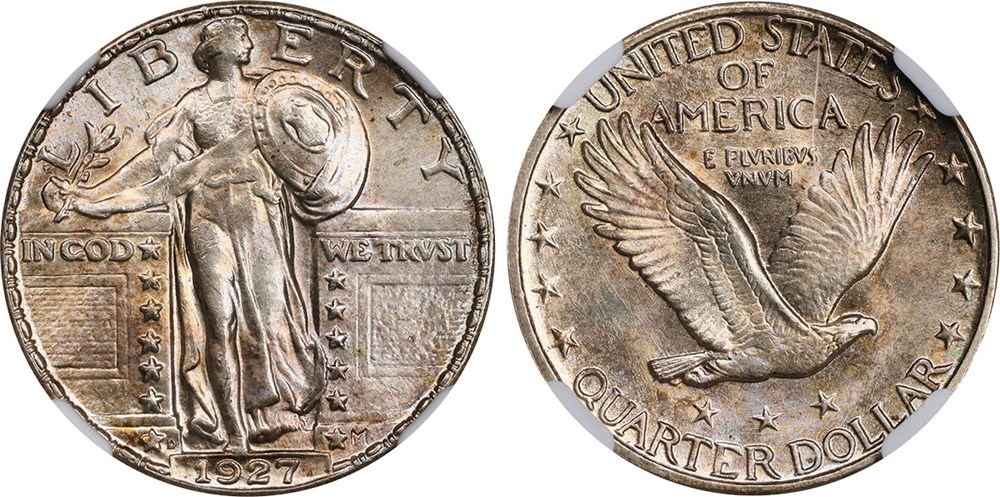
1927-D
- Mintage at Denver – 976,000
- Total mintage (Philadelphia, Denver, San Francisco) – 13,284,000
- Percentage from Denver – 7.3%
The lone Standing Liberty quarter that met the requirement for a production of fewer than one million came late in the series. Production of the quarter dollar was not consistent throughout the series’ lifespan. No Standing Liberty quarters were minted at Denver in the first year of the series as well as 1920–1923 and an additional hiatus in 1925.
The relatively high number of coins made, while only a small percentage of the overall mintage, puts this coin squarely as a mid-range rarity. In the opinion of some, it is not really rare, but becomes quite rare when seeking examples graded with a Full Head designation. The real prize when it comes to 1927 quarters is the San Francisco issue, which saw production of only 396,000, the lowest for the series for the California facility.
Values for the 1927-D tend to be much higher than a Philadelphia issue, but only a fraction of that seen for the San Francisco coins. PCGS CoinFacts shows one example graded MS67FH that brought $34,000 in a 2005 Heritage auction. More recently, Stack’s Bowers brought an MS66+FH with CAC and CMQ certification to the market. This coin sold for $22,800 in June 2025.
1932-D
Mintage at Denver – 436,800
Total mintage (Philadelphia, Denver, San Francisco) – 6,248,800
Percentage from Denver – 7.0%
With the change in design to mark the 200th anniversary of the birth of the nation’s first president George Washington, officials didn’t accurately foresee the impact of the coin. According to NGC, "All three mints struck Washington Quarters, but production at the Denver and San Francisco Mints was limited to the potential number of collectors desiring three-piece sets. This number was actually around 15,000–20,000, but such low mintages would have resulted in the coins selling at a premium from the very start, something the Treasury wished to avoid for fear of criticism.
"Thus, it was that just over 436,000 quarters were coined at the Denver Mint in 1932, a number sufficient to curb speculation at the time. No one could have imagined that millions of persons would be added to the roster of coin collectors a generation later, which led to the hoarding of 1932-D quarters and rapid price increases."
The Coin Resource Center at stacksbowers.com noted that the first year design impacted circulation. "Philadelphia Mint quarters of 1932 were saved in larger numbers due to the novelty of the design. Denver and San Francisco mint issues, produced in small quantities, were also saved, but apparently not to the proportional extent of the Philadelphia pieces."
The design also left open the possibility, like the 1916-D dime, for someone to take a Philadelphia coin and alter it by adding a "D" mintmark. It became yet another example of how certification can make the difference between anguish and joy for those seeking a complete set collection.
Half Dollars
1911-D
- Mintage at Denver – 695,080
- Total mintage (Philadelphia, Denver, San Francisco) – 3,373,080
- Percentage from Denver – 20.6%
Another entry from 1911 made the list as the Barber half dollar saw the lowest output in its Denver run, joining the Barber quarter of the same year. Barber dime production, on the other hand, was at its highest to date with over 11 million coins minted, a mark that would be eclipsed in the years that followed.
David Akers noted at pcgs.com "Despite the low mintage of only 695,080 pieces, the 1911-D is fairly obtainable in all grades up to Very Choice Uncirculated. Even Gems are only moderately rare, but most of them are somewhat lackluster and not particularly attractive…"
The lower mintage doesn’t appear to factor into the value of the coin in the 21st century. A Guide Book of United States Coins 2027 notes that Denver coins are consistently valued at or near the same level as Philadelphia issues, which outnumber 1911-D halves by better than two-to-one.
Stack’s Bowers sold one of the six MS67 1911-D half dollars on the PCGS census for $12,000 in 2024. The coin was offered again in 2026, yielding $9,600. In that same sale, an example graded MS63 by NGC was sold for just $900, a steep drop in price. Prior to the Stack’s Bowers sale, another MS67 pedigreed to the Eliasberg Collection was sold by Heritage for $15,525 in 2005.
1913-D
- Mintage at Denver – 534,000
- Total mintage (Philadelphia, Denver, San Francisco) – 1,346,000
- Percentage from Denver – 40.3%
In an unusual turn of events, the Denver mint produced fewer than one million coins but still made almost half of the coins. In 1913, the Philadelphia Mint only made 188,000 Barber half dollars. It was one of the few times when the branch mints out produced the main operation. As such, when it comes to rarity, Philadelphia coins are far and away more highly desired.
Price guides indicate a substantial difference between a 1913 Barber half and a 1913-D Barber half, helped out by the mintage difference. Interestingly, auction sales sometimes don’t show as much of a gap though the 1913 is not frequently seen being offered. Heritage sold an example of each in 2022. Stack’s Bowers presented a pair of 1913-D in Mint State grades in September 2025, but the last 1913 Barber half in Mint State was sold in January 2024. Several Proof strikes have been offered in the interim.
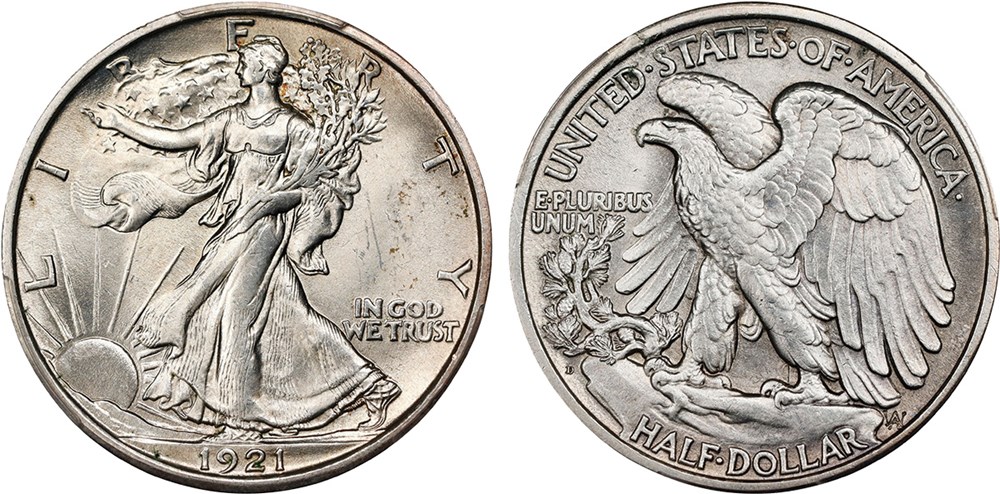
1921-D
- Mintage at Denver – 208,000
- Total mintage (Philadelphia, Denver, San Francisco) – 1,002,000
- Percentage from Denver – 20.8%
There wasn’t an abundance of 1921 Liberty Walking half dollars made anywhere, with attention shifting to the renewed production of silver dollars at the three mints. San Francisco led the way in making 1921 Liberty Walking halves with 548,000, followed by Philadelphia with 246,000. Denver’s 208,000 is noted by David Hall on pcgs.com, "The 1921-D is the lowest mintage Walking Liberty half dollar and it is very rare in low grades. It is also the most expensive Walker in the very lowest grades." To back up that remark, A Guide Book of United States Coins 2027 puts the 1921-D at $470 in VG8, compared to the value of the 1921-S at $130. In higher grades, the San Francisco issues will catch and pass the Denver coins.
It would be eight years before Denver made another half dollar and then only sporadically. Production of the Peace dollar was also hit or miss but fractional coins continued to be produced, keeping the Denver Mint busy.
There have been several six figure sales for the 1921-S Liberty Walking half dollar, but that’s a level that neither Philadelphia or Denver has achieved with any regularity. The exception would be the Steven L. Duckor 1921-D half dollar sold for $168,000 by Heritage Auctions in 2018. Graded PCGS MS66 with a CAC green sticker, the coin had previously sold for $94,000.
1938-D
- Mintage at Denver – 491,600
- Total mintage (Philadelphia, Denver) – 4,601,600
- Percentage from Denver – 10.7%
The final entry in the sub-one million class is the 1938-D Liberty Walking half. David Hall noted on pcgs.com that collectors started saving rolls in 1934, so this example may be more readily available in an uncirculated condition. It ranks as the third lowest mintage in the Liberty Walking series.
The 1938-D has seen an uptick in auction appearances at Stack’s Bowers with 27 examples offered in the past two years, half of them in Mint State grades. Heritage has sold 25 in 2026 (through August) including the top coin on the NGC census report, which brought $10,980 as part of the FUN U.S. Coins Signature Auction.
Value guides show a drastic jump at the Mint State grade for Denver products when compared to Philadelphia or San Francisco.
Related Stories (powered by Greysheet News)
View all news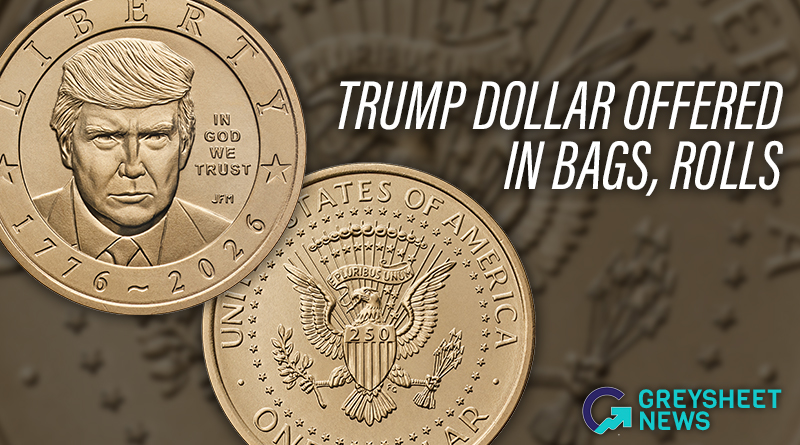
In early September, the U.S. Mint began selling bags and rolls of Semiquincentennial one-dollar coins.

The United States Mint has selected 37 American artists to participate in its Artistic Infusion Program (AIP) to create and submit new designs for coins and medals.
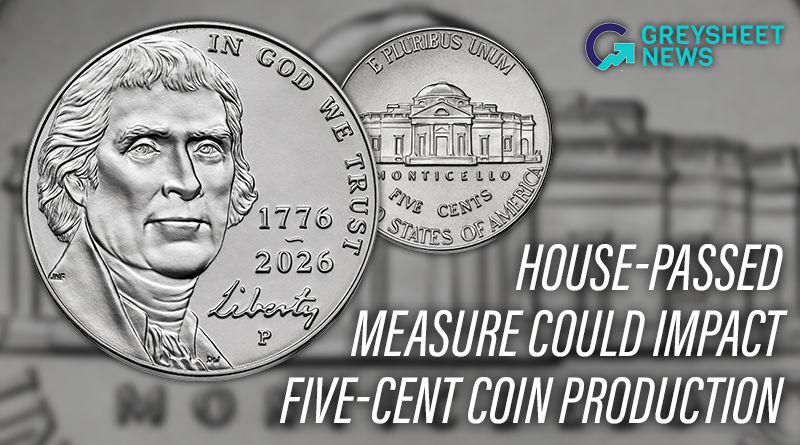
Because the nickel is a repeat offender in excessive production cost, H.R. 3074 proposes steps to reduce the cost of producing the coin.
Please sign in or register to leave a comment.
Your identity will be restricted to first name/last initial, or a user ID you create.
Comment
Comments