


 Whitman Expo
Israel. Hebrew University Features on Latest Gold Coin in Jerusalem of Gold Bullion Series.
The Bank of Israel launch new bullion gold coins in their on-going and popular series.
by Michael Alexander |
Published on June 3, 2025

Download the Greysheet app for access to pricing, news, events and your subscriptions.

Subscribe to RQ: Red Book Quarterly for the industry's most respected pricing and to read more articles just like this.
Launched in 2010, the series highlights historic sites and landmarks in the city of Jerusalem captured in pure gold. The 15th bullion design in the series is dedicated to the Hebrew University of Jerusalem. An institution older than the State of Israel itself, it has laid the foundation for higher education, played a significant role in shaping the State of Israel and serves to this day as a source of inspiration for future generations. Rooted in the heart of Israeli nationhood, the Hebrew University of Jerusalem is the backbone of a vision that was realised to establish the university which was first conceived at the First Zionist Congress in Basel in 1897. However, the project did not become a reality until 1913 when the 11th Zionist Congress approved the foundation of the Hebrew University in Jerusalem. It would be the first university to be established in the heart of Jerusalem by the Jewish people for the Jewish people. Five years later in 1918, the first twelve cornerstones for the university were laid down – each cornerstone symbolising the twelve Tribes of Israel - during the era of the British Mandate Government. The official opening ceremony of the campus took place on the 1st April 1925 on Mount Scopus, in the presence of thousands, including distinguished personalities from across the globe, among them Lord Balfour, Zionist Organization President Chaim Weizmann, Chief Rabbi Abraham Isaac Kook, and national poet Chaim Nachman Bialik.
Initially, the Hebrew University concentrated exclusively on research and only at a later stage, broadened its scope of activity to include education and the sciences. During Israel’s War of Independence commencing in 1948 and which ended the British Mandate, studies on the Mount Scopus campus were interrupted and the area came under Jordanian rule. From 1950 onward, access to the University was denied to Israelis who began construction of a new campus in 1955 at Givat Ram in western Jerusalem which completed in 1958. The new central campus was inaugurated as part of Israel’s tenth anniversary celebrations, and was followed by the establishment of additional new institutions, among them the Hadassah Hospital in Ein Karem and the Harry S. Truman Research Centre. After the Six Day War in 1967, Israeli rule was restored to Mount Scopus and in 1981 the renewed University Campus was inaugurated. During the following decades, the Hebrew University continued to expand and developed with additional faculties opened to include the faculties for veterinary medicine, engineering and computer science.
The Hebrew University of Jerusalem continues to be ranked among the world’s top universities and is home to the largest Jewish studies library in the world. Prime ministers of Israel count among the university’s alumni and supporters of its founding included Albert Einstein, who also donated his papers to the university archives. Today, Hebrew University is attended by a diverse population of students. Israelis and Israeli Arabs mingle freely in the halls, along with foreign students from countries around the world. The Hebrew University remains to this day, a living symbol of the spirit of the Jewish people, its scientific research, and rich culture, connecting between heritage and aspirations for the future.
Of notoriety it the University’s water tower on Mount Scopus, which located on the campus and rising 55 meters in height. It was built in 1970 and is also one of the city’s most recognisable landmarks. Initiated in 2021, the tower is undergoing renovation and will be transformed into an observatory with a cafe and exhibition spaces. This project when complete will offer breath-taking views from the Dead Sea to the Mediterranean. The observatory will serve as a public space, an official meeting place for the university, and a venue for highlighting University achievements.
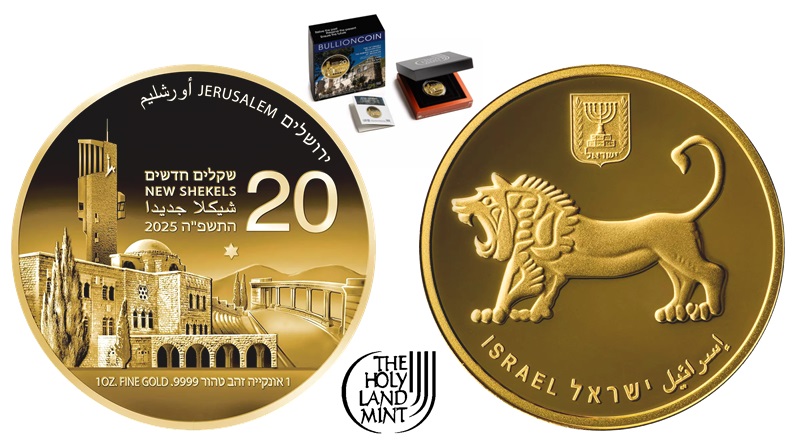
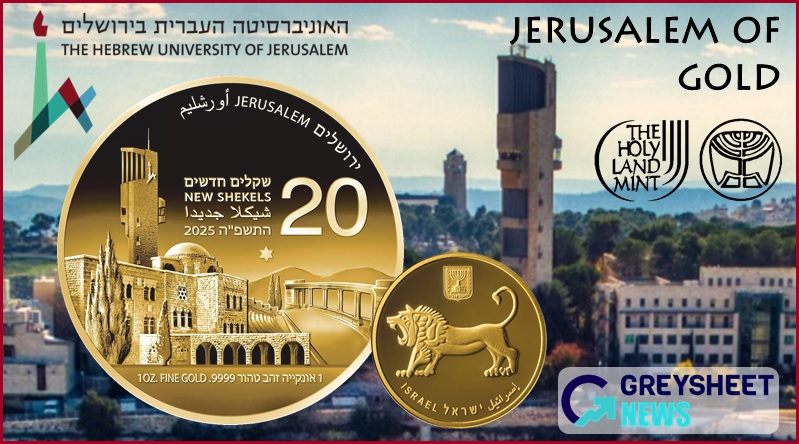
The coins are produced by the Holy Land Mint at their facilities in Nesher, Haifa on behalf of the Bank of Israel and designed by Aharon Shevo. Obverse side features a front view of the Hebrew University Campus on Mount Scopus, showing the university emblem, against a background of the Jerusalem hills and cypress trees. To the left is a representation of the Rothberg amphitheatre and clearly visible is the University’s familiar water tower landmark which is currently undergoing renovation. The numeral 20 is placed to the right of the primary design with the text NEW SHEKELS shown in Hebrew, English and Arabic along with the year 2025 in English and Hebrew along the Star of David mintmark, placed to the left of the denomination. Below the depiction of the University are the coins’ specifications 1 OZ FINE GOLD .9999 in English and Hebrew The upper right border includes the text JERUSALEM in English, Hebrew and Arabic. The reverse side which is common to all coins in the series is designed by Meir Eshel and depicts a stylised Lion of Megiddo with its accentuated curved tail. The loin motif is based on an ancient 8th century BC seal excavated in Megiddo (Armageddon) in the Jordan Valley that belonged to Shema, servant of King Jeroboam II. Above the lion is the Israel State Emblem and below is the text ISRAEL in English, Hebrew and Arabic.
| Denomination | Metal | Weight | Diameter | Quality | Mintage Limit |
| 20 Shekels | .9999 Gold | 31.1 g. | 32 mm. | BU | 3600 |
Available from the 26th May, each coin is encapsulated and presented in a polished hardwood custom case accompanied with a certificate of authenticity. Estimated dates for delivery are scheduled for the beginning of July. For additional information, please visit the e-webshop of the Holy Land Mint.
Related Stories (powered by Greysheet News)
View all news
New coins from Austria, Hungary, and the United Kingdom.


New coins from Australia, China, and the Netherlands.
New coins from the Falkland Islands, Gibraltar, and Malta.
Please sign in or register to leave a comment.
Your identity will be restricted to first name/last initial, or a user ID you create.
Comment
Comments