


 Whitman Expo
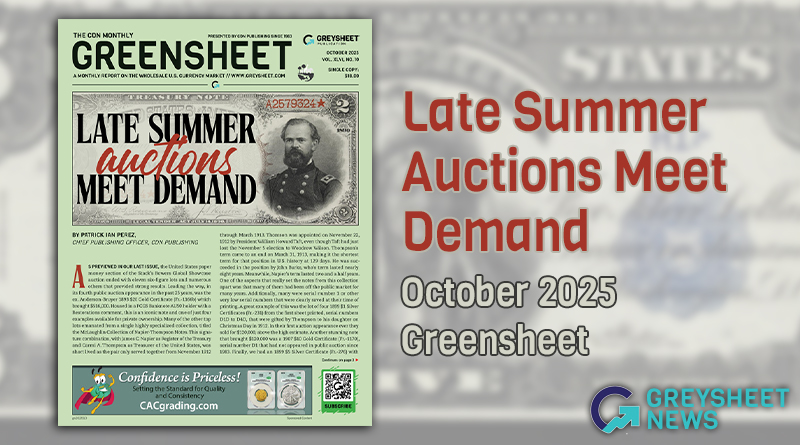
October 2025 Greensheet Market Analysis: Late Summer Auctions Meet Demand
Paper money in the Stack’s Bowers Global Showcase auction yielded strong results.
by Patrick Ian Perez |
Published on October 2, 2025

Download the Greysheet app for access to pricing, news, events and your subscriptions.
Subscribe to Greensheet for the industry's most respected pricing and to read more articles just like this.
As previewed in our last issue, the United States paper money section of the Stack’s Bowers Global Showcase auction ended with eleven six-figure lots and numerous others that provided strong results. Leading the way, in its fourth public auction appearance in the past 25 years, was the ex. Anderson-Bruyer 1893 $20 Gold Certificate (Fr.-1166b) which brought $516,000. Housed in a PCGS Banknote AU50 holder with a Restorations comment, this is an iconic note and one of just four examples available for private ownership. Many of the other top lots emanated from a single highly specialized collection, titled the McLaughlin Collection of Napier-Thompson Notes. This signature combination, with James C. Napier as Register of the Treasury and Carmi A. Thompson as Treasurer of the United States, was short lived as the pair only served together from November 1912 through March 1913. Thomson was appointed on November 22, 1912 by President William Howard Taft, even though Taft had just lost the November 5 election to Woodrow Wilson. Thompson’s term came to an end on March 31, 1913, making it the shortest term for that position in U.S. history at 129 days. He was succeeded in the position by John Burke, who’s term lasted nearly eight years. Meanwhile, Napier’s term lasted two and a half years. One of the aspects that really set the notes from this collection apart was that many of them had been off the public market for many years. Additionally, many were serial number 1 or other very low serial numbers that were clearly saved at their time of printing. A great example of this was the lot of four 1899 $1 Silver Certificates (Fr.-231) from the first sheet printed, serial numbers D1D to D4D, that were gifted by Thompson to his daughter on Christmas Day in 1912. In their first auction appearance ever they sold for $120,000, above the high estimate. Another stunning note that brought $120,000 was a 1907 $10 Gold Certificate (Fr.-1170), serial number D1 that had not appeared in public auction since 1983. Finally, we had an 1899 $5 Silver Certificate (Fr.-276) with the serial number H1 that was surely a treasured possession of Thompson. In this note’s first ever auction appearance it sold for $96,000 against a high estimate of $70,000. In Small Size currency, the sale featured multiple runs of consecutive Series 1934A $500 Federal Reserve Notes that led the way. Viewing the auction as a whole, the impression is that the currency market is very steady, but not as hot as a year ago. There are fewer sellers willing to part with their material, making the competition for fresh offerings that much fiercer.
Another component of the Global Showcase sale was world paper money, with Stack’s Bowers selling 728 of 776 lots offered. With a focus on notes solely issued in the Americas, the top five highest priced lots were all British Colonial pieces. The top lot, a British Guiana 100 dollar note from 1942 (BNB B112a) is an extreme rarity in world paper and the final price reflected that, selling for $78,000. In second place was a Specimen 10 shillings note issued by the Government of the Leeward Islands (BNB B103as), a very short-lived issuer which only issued three denominations in 1921. This Specimen 10 shillings piece sold for $37,200 against a high estimate of $30,000. Nine other lots in the sale sold for greater than $10,000, including pieces from Canada, Colombia, and Martinique. There was a significant selection of Canadian notes, both Chartered Banks and Federal issues. The results could be deemed moderate, although the Dominion notes performed the best of the three major subcategories.
One other important note concerning world paper money is the offering of the paper money from the L.E. Bruun Collection on October 28. While this collection will be long remembered as the finest Scandinavian coin collection to ever come to market, the paper money should not be overlooked. It consists of 232 lots of notes from Denmark, Greenland, Iceland, and Norway and includes many scarce types.

Related Stories (powered by Greysheet News)
View all news
The rare coin market so far in 2026 has been somewhat volatile, with greater price swings happening over a shorter period of time when compared to historical norms.

While reviewing the initial results in various categories of recent auctions, my initial take is that the sales were moderate to strong.
Outside of the direct trading of coins, our industry has seen some shake up recently on the data and information front.
Please sign in or register to leave a comment.
Your identity will be restricted to first name/last initial, or a user ID you create.
Comment
Comments