




 Whitman Expo
October 2026 Greensheet Market Analysis: Collector Grade Notes Strong
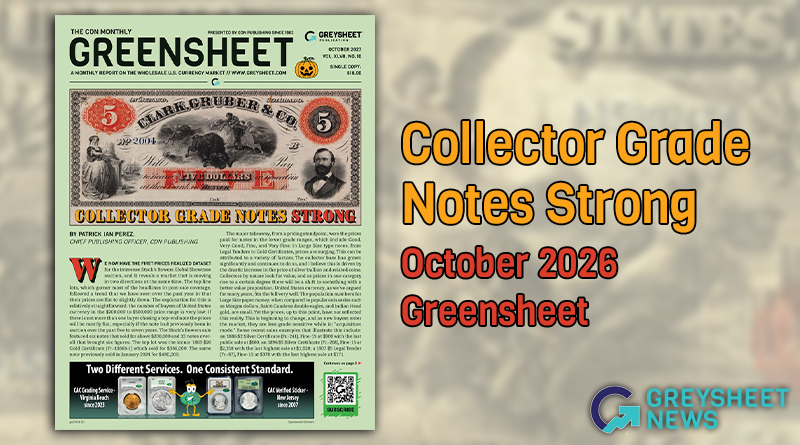
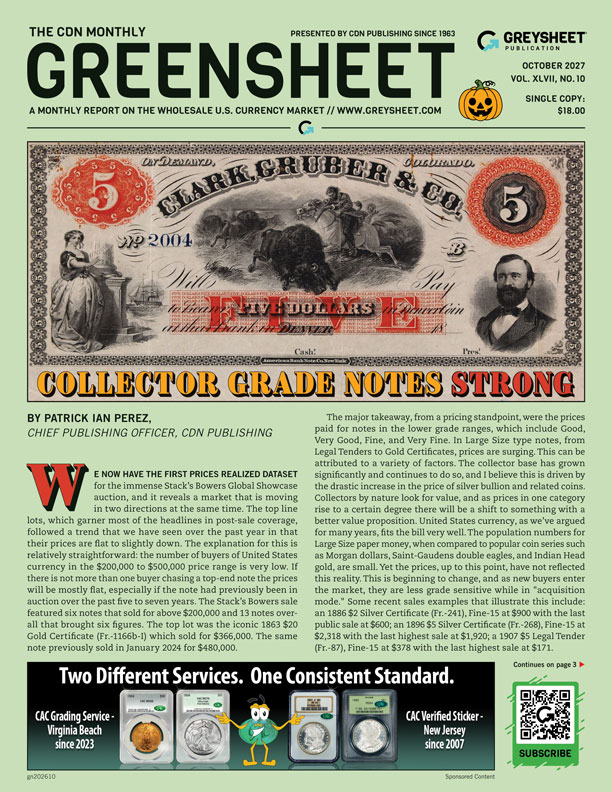
We now have the first prices realized dataset for the immense Stack’s Bowers Global Showcase auction, and it reveals a market that is moving in two directions at the same time.
by Arthur Friedberg |
Published on October 7, 2026

Download the Greysheet app for access to pricing, news, events and your subscriptions.
Subscribe to Greensheet for the industry's most respected pricing and to read more articles just like this.
The top line lots, which garner most of the headlines in post-sale coverage, followed a trend that we have seen over the past year in that their prices are flat to slightly down. The explanation for this is relatively straightforward: the number of buyers of United States currency in the $200,000 to $500,000 price range is very low. If there is not more than one buyer chasing a top-end note the prices will be mostly flat, especially if the note had previously been in auction over the past five to seven years. The Stack’s Bowers sale featured six notes that sold for above $200,000 and 13 notes overall that brought six figures. The top lot was the iconic 1863 $20 Gold Certificate (Fr.-1166b-I) which sold for $366,000. The same note previously sold in January 2024 for $480,000.
The major takeaway, from a pricing standpoint, were the prices paid for notes in the lower grade ranges, which include Good, Very Good, Fine, and Very Fine. In Large Size type notes, from Legal Tenders to Gold Certificates, prices are surging. This can be attributed to a variety of factors. The collector base has grown significantly and continues to do so, and I believe this is driven by the drastic increase in the price of silver bullion and related coins. Collectors by nature look for value, and as prices in one category rise to a certain degree there will be a shift to something with a better value proposition. United States currency, as we’ve argued for many years, fits the bill very well. The population numbers for Large Size paper money, when compared to popular coin series such as Morgan dollars, Saint-Gaudens double eagles, and Indian Head gold, are small. Yet the prices, up to this point, have not reflected this reality. This is beginning to change, and as new buyers enter the market, they are less grade sensitive while in “acquisition mode.” Some recent sales examples that illustrate this include: an 1886 $2 Silver Certificate (Fr.-241), Fine-15 at $900 with the last public sale at $600; an 1896 $5 Silver Certificate (Fr.-268), Fine-15 at $2,318 with the last highest sale at $1,920; a 1907 $5 Legal Tender (Fr.-87), Fine-15 at $378 with the last highest sale at $171.
There are dozens more examples, but the trend is clear. The word of caution here is speculation. Much of the momentum in the market is being generated via live streaming sale platforms, which has become the double-edged sword of creating more collectors as I mention above while at the same time fueling speculative buying. The idea of collecting numismatics solely on monetary value should be separated from the historical and intellectual aspects. An accumulation does not become a collection unless there is an understanding of the material, and a thoughtful organization and intention to build something with a cohesive theme. Otherwise, these same notes that are bringing strong prices today may be unceremoniously sold back into the market at lower prices in the future as people lose interest and move on to the next fad.
IMPORTANT CORRECTION
I wanted to alert readers to a typographical error that was found in a Whitman book that was published earlier this year. On page 74 of the Red Book Series: United States Paper Money, 9th Edition, which was released in February, there is a pricing chart for $2 Federal Reserve Notes. A somewhat obscure modern note, the Series 2017A $2 FRN Star note from the New York district (Fr.-1941B*) has a listed price of $250; this is not correct. The value is supposed to read $25. This is a curious situation, as the note was listed with a value of $250 in the 8th Edition of the same book which was published in late 2024. This original value was accurate at the time because of the uncommon nature of how this note was printed by the Bureau of Engraving and Printing. Back in December 2021, the initial print run was for serial numbers B00000001* through B00032000*, so at the time it seems this was a modern rarity with only 32,000 examples printed. Fast forward to July 2024, more than two and half years later, when the BEP printed serial number runs B03200001* to B03360000* and B06400001* to B09600000*, thus making the total number printed 3,392,000. An argument can be made that at the time of the 8th Edition the $250 price was realistic, but with the additional printing the price should have been updated in the 9th Edition. Fortunately, the market has borne this out, with Stack’s Bowers selling a few original packs of this note at auction for prices between $700 and $900. For specialists, the notes of the first print run are significantly scarcer, but we will not speculate on the value at this time. Any sellers offering this note as rare are not being forthright.

Related Stories (powered by Greysheet News)
View all news
It is possible that an American woman will now appear on a European banknote before one from the United States.

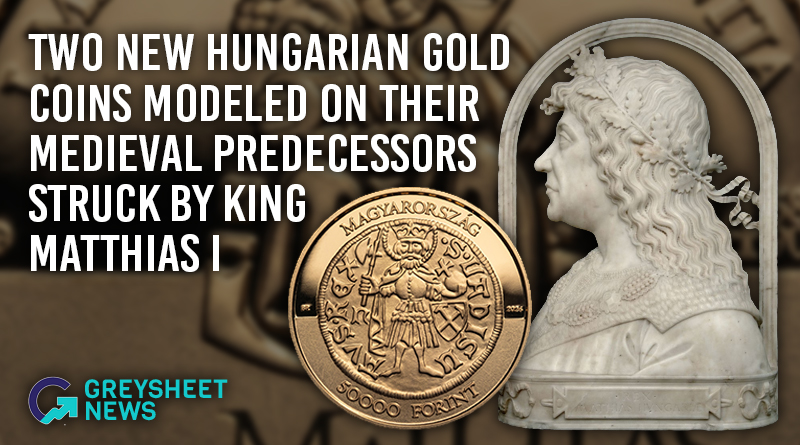
In 2026, The Hungarian Mint is issuing a gold collector coin called “The Gold Florin of Matthias I”, in single-ducat weight and quadruple-ducat weight (piedfort) versions, as well as a base metal version in a copper-nickel-zinc alloy.
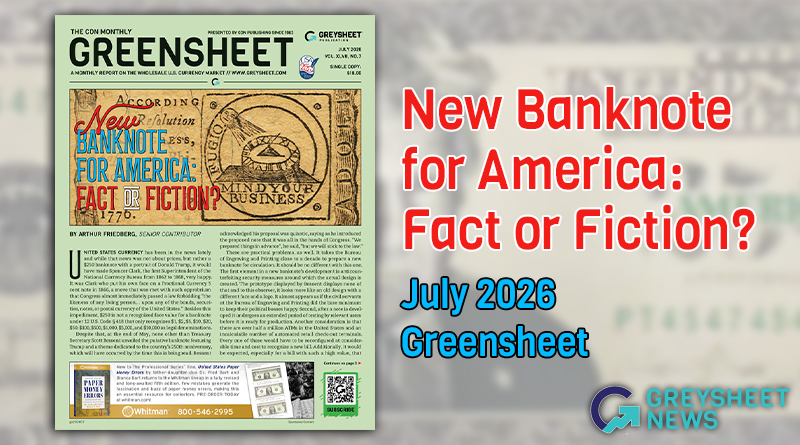
At the end of May, Treasury Secretary Scott Bessent unveiled a $250 banknote featuring Trump and a theme dedicated to the country's 250th anniversary.
Please sign in or register to leave a comment.
Your identity will be restricted to first name/last initial, or a user ID you create.
Comment
Comments