


 Whitman Expo
Premiums Drop on Bullion Coins: the Business of Numismatics (September 2023 Greysheet)
Premiums across multiple market segments have fallen, most auspiciously for American Silver Eagles.
by Patrick Ian Perez |
Published on August 29, 2023


Download the Greysheet app for access to pricing, news, events and your subscriptions.
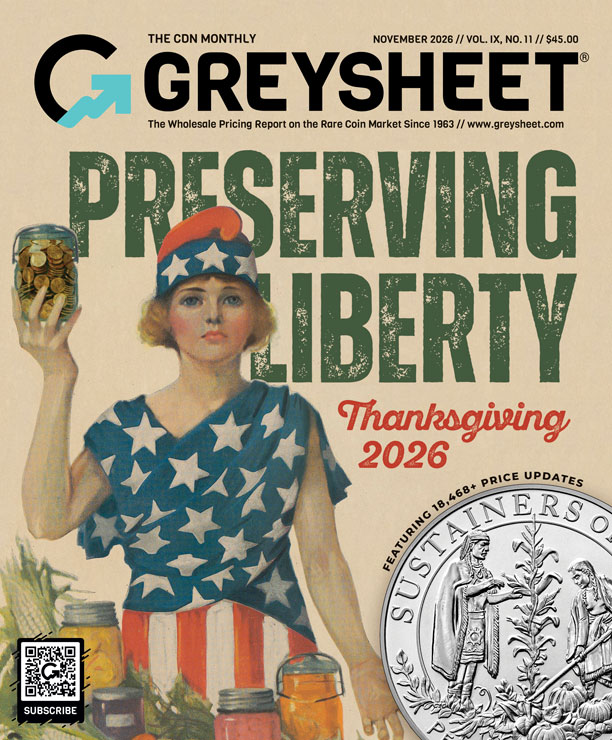
Subscribe to Greysheet for the industry's most respected pricing and to read more articles just like this.
The rare coin market enters the final four months of the year under tightening conditions. Premiums across multiple market segments have fallen, most auspiciously for American Silver Eagles. This is a very recent development, as the premiums on these most popular bullion coins have been unprecedentedly high for the entire year. The has been no major correction in the silver spot price, which is still well above $23 per ounce as of this writing. As a comparison, over the past couple months the prevailing wholesale ask price was in the range of $7.50 to upwards of $9 over spot per coin. They are now available in the $2.75 to $3.50 range over silver spot. Likewise, premiums on circulated and low Mint State Double Eagles have also evaporated, with Very Fine to About Uncirculated coins selling for very little over melt value. We have seen this market cycle more than once in the past, and it seems to be sparked by an extended period of high precious metals prices. What seems to occur is an initial rush of retail bullion buyers when gold and silver spot start spiking, thus pushing premiums higher, but once they stay at elevated levels, the demand wanes. It then becomes very capital intensive for dealers to buy and/or stock large amounts of gold, so the premiums slide backwards. From a macro point of view, the rare coin market has been somewhat insulated from the travails of the global market for the past 12 months, but this seems to be ending. Although the tech rally has come and gone in the equity markets, the majority opinion is that the Fed will either continue to hike interest rates, or at the least hold steady. The reality of high costs of capital are impacting what large wholesalers and market makers can spend. Liquidity, which is always at a premium in this business, is drying up. Dated $20 Liberty coinage has also softened, and from a retail buying point of view, this is the time where one can buy coins with much lower population numbers at basically the same price as the most common dates.
Speaking of gold coinage, the Stack’s Bowers Global Showcase auction in August featured another installment of pieces from the Fairmont Collection, this one being dubbed the Rhone Set which consists of 458 coins. It is very interesting to think about the impact of this hoard, as it has provided multiple examples of virtually every date of United States gold coin from 1850 to 1932, across all major denominations. Often, the coins are in the very appealing collector grades of Very Fine, Extra Fine, and About Uncirculated. With the exception of the key dates, this makes the coins accessible to a rather wide cross section of buyers. Those collectors who perhaps thought owning an early U.S. gold coin was out of reach now have the opportunity to acquire one or two pieces, and who knows what kinds of spark that will provide. Also crucially, almost all of the Fairmont coins are fully original; of the 458 coins in the Rhone set, 203 (44%) have received CAC stickers. While the auction session has not yet taken place as I write this, the standout coins of the Rhone Set include a 1909-O $5 Indian, PCGS MS62, an 1862 $20 Liberty, PCGS/CAC AU50, and an 1874-CC $20 Liberty, PCGS/CAC AU58. With exception of a few individuals, no one knows the extent of the Fairmont Collection. There could be one more offering or five more; the one thing that is certain is that the Fairmont pedigree will be long-lived and will be a fixture in future auction catalogs and numismatic literature.
Sincerely,
Patrick Ian Perez

Related Stories (powered by Greysheet News)
View all news
The rare coin market so far in 2026 has been somewhat volatile, with greater price swings happening over a shorter period of time when compared to historical norms.

While reviewing the initial results in various categories of recent auctions, my initial take is that the sales were moderate to strong.
Outside of the direct trading of coins, our industry has seen some shake up recently on the data and information front.
Please sign in or register to leave a comment.
Your identity will be restricted to first name/last initial, or a user ID you create.
Comment
Comments