


 Whitman Expo
Spain. Gold and Silver Proof Coin Set Celebrates American Semiquincentennial Anniversary of Independence
The FNMT release the first coins in a special series marking 250 years of America’s Independence.
by Michael Alexander |
Published on October 22, 2025

Download the Greysheet app for access to pricing, news, events and your subscriptions.

Subscribe to RQ: Red Book Quarterly for the industry's most respected pricing and to read more articles just like this.
Known nationally in the United States as the America250 commemoration, the anniversary marks the 250th anniversary of the Declaration of Independence. Fifty six colonial delegates representing the 13 colonies signed the document on the 4th July 1776 in Philadelphia. Spain, through its alliance with France and as part of its conflict with Britain played an important role in the independence of the United States. The Spanish Crown declared war on Britain as an ally of France, itself an ally of the American colonies. Most notably, Spanish forces attacked British positions in the southern half of North America and captured West Florida from Britain in the siege of Pensacola. This secured the southern route for supplies and closed off the possibility of any British offensive through the western frontier of the soon-to-be United States via the Mississippi River. Spain was also invaluable to the cause of the colonies by providing money, supplies and munitions to the Continental Army forces.
As such, Spain's contribution to the cause of the American Revolutionary War and it’s declaration of independence was widely regarded internationally as a successful endeavour. The Spanish took a gamble in entering the war, banking on Great Britain's vulnerability caused by the involvement of fighting their rebellious colonists in North America while also conducting a multi-regional war on many fronts against a coalition of major powers. As a result of their support of the Colonists, this helped Spain gain some relatively easy conquests in terms of newly acquired territories.
The war gave a needed boost to the Spanish kingdom's prestige, which had suffered from the losses to Britain in the Seven Years' War. Even though Spain's single most coveted target –that of Gibraltar remained out of its grasp, Spain had more than compensated this disappointment by recovering Menorca and by reducing the British threat to its own colonies in and around the Caribbean, all of which were seen as vital to Spanish interests.
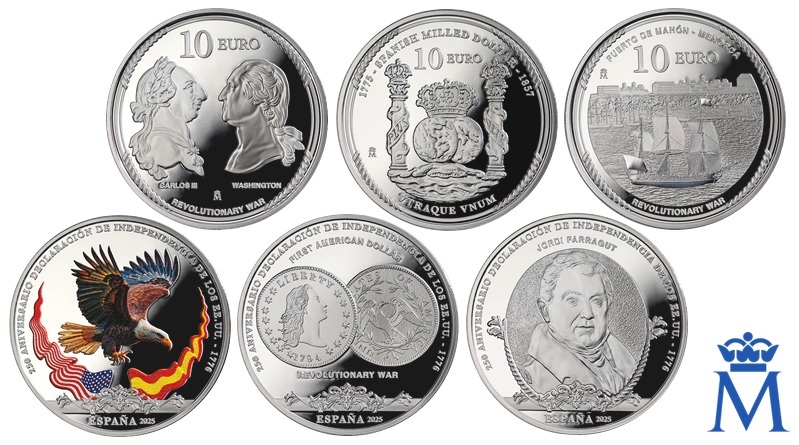
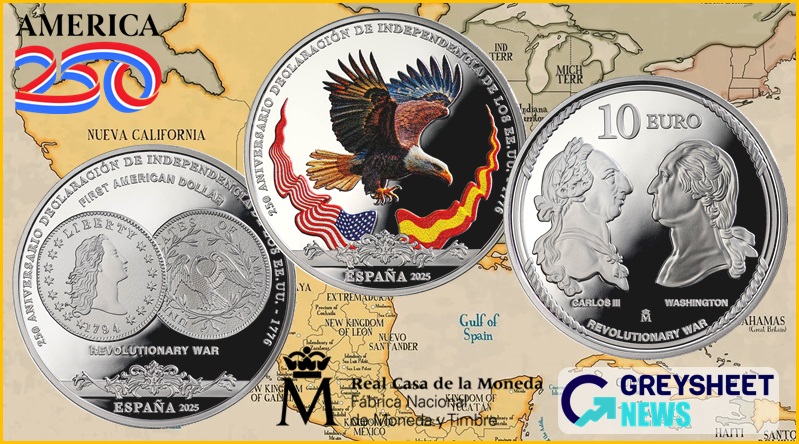
Coin 1. Spain contributed to the American Revolution through direct military action, vital financial and material aid, and by forcing Britain to fight on multiple fronts. Their military campaigns in the south against British forces in Florida and Louisiana secured a crucial supply route via the Mississippi River. Diego María de Gardoquí y Arriquibar (1735 – 1798) was Spain's first envoy to the United States and became well acquainted with George Washington, marching in the newly elected President Washington's inaugural parade. King Carlos III of Spain also continued communications with Washington until his death in 1788. The obverse side features a colourful image of a bald eagle within a decorative, ornate base from which emerge the flags of the United States of America and Spain. The legend 250 ANIVERSARIO DECLARACIÓN DE INDEPENDENCIA DE LOS EE.UU. - 1776. (250th Anniversary of the Declaration of Independence of the United States – 1776) surrounds the primary design along the rim. At the bottom, horizontally and in capital letters, appears the legend Spain 2025. The reverse features the facing replicated coin effigies of the King of Spain Carlos III and George Washington. Below the likeness of each is the text CARLOS III and WASHINGTON along with the mint mark, a crowned M denoting the Mint of Madrid. Above the primary design is the denomination 10 EURO and along the lower rim, the additional commemorative text REVOLUTIONARY WAR. The primary design is surrounded by an ornamental composition.
Coin 2. Often referred to as a ‘Piece of eight’ due to the number of reales equalling one Spanish milled dollar, they lost their legal tender status in the United States on the 21st February 1857 with the passage of the Coinage Act of 1857. This act ended the status of all foreign coins as legal tender in the United States, making the Spanish dollar and other foreign silver and gold coins obsolete for official use. As a result, many Spanish coins were exchanged at the Treasury and re-coined into US currency. The milled part of a Spanish milled coin referred to the reeded edges that discouraged shaving the valuable silver off of the coins. This security feature was also incorporated onto American gold and silver coinage.
The obverse features an image of the obverse and reverse of the first American silver dollar, centred. The legend 250 ANIVERSARIO DECLARACIÓN DE INDEPENDENCIA DE LOS EE.UU. - 1776. (250th Anniversary of the Declaration of Independence of the United States – 1776) surrounds the primary design along the rim. Placed above the image of the dollar in an arched shape is the text FIRST AMERICAN DOLLAR. Below the two dollar images is the additional text REVOLUTIONARY WAR which is placed above an ornate decorative base along with the text ESPAÑA 2025. The reverse side replicates elements of the design found on the famous Spanish silver coin of eight Reales known as the ‘Pillar Dollar’. Above the primary design is the inscription 1775 – SPANISH MILLED DOLLAR – 1857 and just below, the denomination 10 EURO. Below and along the lower rim is the motto VTRAQUE VNUM - a Latin phrase that translates to ‘Both are one’ which was included on Spanish colonial coins referencing the unity of the Old and New World. The mint mark, a crowned M denoting the Mint of Madrid is placed to the lower left near the pillar.
Coin 3. Remembered as the only known Spanish volunteer who fought under the American flag in the Revolutionary War, Jorge Farragut Mesquida was a Spanish American naval officer. Born in Ciutadella de Menorca, then under British occupation, he fought during the American Revolutionary War and with the Continental Army in battles in the South. Farragut took up arms once again against the British as a volunteer companion to General Andrew Jackson’s troops during the War of 1812.
The obverse features a front-facing portrait of Jordi Farragut, centred. Above the portrait is the legend 250 ANIVERSARIO DECLARACIÓN DE INDEPENDENCIA DE LOS EE.UU. - 1776. (250th Anniversary of the Declaration of Independence of the United States – 1776) and along the rim. Just above the image, his name JORDI FARRAGUT shown in a slight arch-shape. Below the base of Farragut’s image is the text ESPAÑA 2025. The reverse features an illustration of the port of Mahón in the 17th century and above, the denomination 10 EURO and Mint of Madrid’s crowned M mintmark. Along the upper rim above the primary design is the inscription PUERTO DE MAHÓN – MENORCA. along the lower rim is the additional commemorative text REVOLUTIONARY WAR. The primary design is surrounded by an ornamental composition.
When complete, the commemorative set will include ten coins including a gold four-escudo coin with a face value of 200 euros, a silver Cincuentín coin with a face value of 50 euros, and five additional eight-real coins with a face value of 10 euros.
| Denomination | Metal | Weight | Diameter | Quality | Mintage Limit |
| 10 Euro X 3 | .925 Silver | 27 g. | 40 mm. | Proof | 10,000 each |
Each coin is encapsulated and presented in a custom case accompanied with a numbered certificate of authenticity. The coins in the series issued in 2025 and 2026 may be sold individually or as part of collections. For additional information, please visit the e-webshop of the Real Casa de la Moneda.
Related Stories (powered by Greysheet News)
View all news
New coins from France, Germany, and Switzerland.

New coins from Austria, Hungary, and the United Kingdom.
New coins from Australia, China, and the Netherlands.
Please sign in or register to leave a comment.
Your identity will be restricted to first name/last initial, or a user ID you create.
Comment
Comments