




 Whitman Expo
The March of Dimes
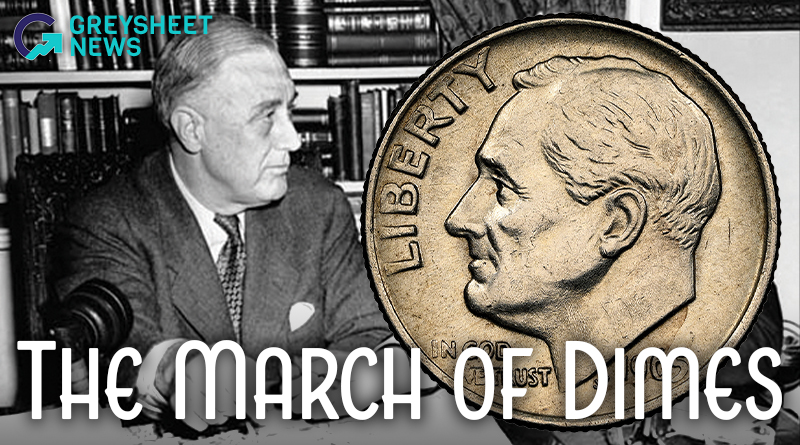
The Roosevelt Dime was introduced shortly after his Franklin D. Roosevelt's death as a tribute to his relationship with the "March of Dimes."
by Michael Garofalo |
Published on July 8, 2025

Download the Greysheet app for access to pricing, news, events and your subscriptions.
Subscribe to Greysheet for the industry's most respected pricing and to read more articles just like this.
Many consider Franklin Delano Roosevelt (FDR) one of America’s greatest Presidents. In fact, the top two candidates for that honor are usually Abraham Lincoln and FDR. Lincoln is considered because he abolished slavery and led the country through the Civil War. FDR is considered because he set the country on the right path during the Depression he inherited when he was first elected, and because he guided America through World War II.
My own parents, who lived through both of those cataclysmic events, told me that they each voted for FDR—four times! Roosevelt won election in 1932, 1936, 1940, and 1944. He was the only president who served more than two terms, which is theoretically impossible today. My father used to joke, "We elected Roosevelt four times, and if he were still alive today, he would still be president!"
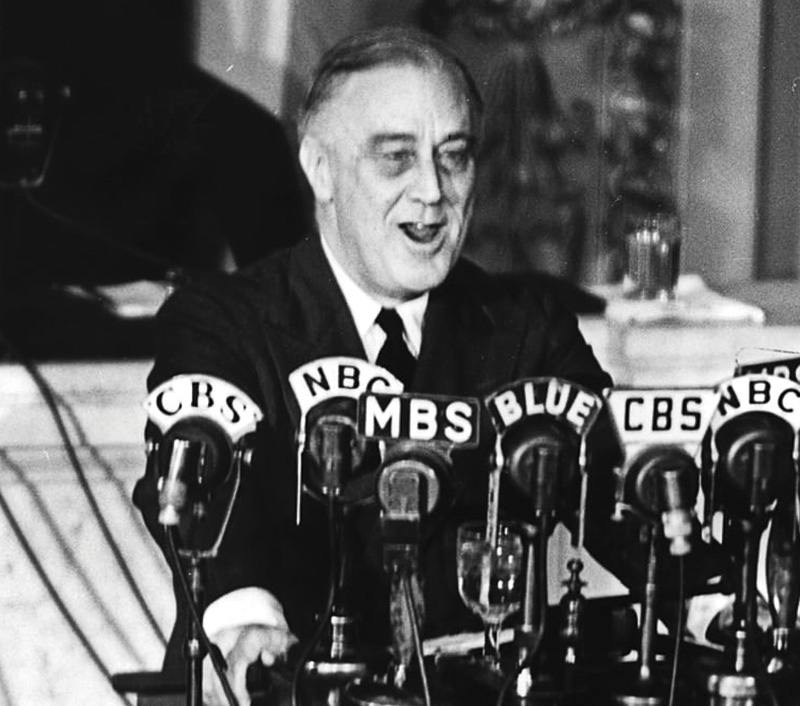
Franklin was born into the prominent Roosevelt family and was a cousin to Teddy Roosevelt. He served in the New York State Senate and became Secretary of the Navy in the Wilson Administration during World War I. After the War, FDR became James Cox’s Vice Presidential running mate in 1920, but they were defeated. In 1921, FDR contracted a paralytic illness that permanently paralyzed his legs. His wife, Eleanor, encouraged him to get involved in politics again and he ran for Governor of New York, where he served from 1929 to 1932.
During FDR’s first two terms as President, he fought the Depression that was debilitating the country and for which former President Herbert Hoover had no adequate response. Roosevelt campaigned and won on his proposed "New Deal," which created national service jobs for the unemployed and also implemented a Social Security program that financially assisted the elderly, the poor, and people with disabilities. To stop even more banks from becoming insolvent, his administration created the Federal Deposit Insurance Corporation (FDIC), which guaranteed depositors’ money in FDIC-insured banks.
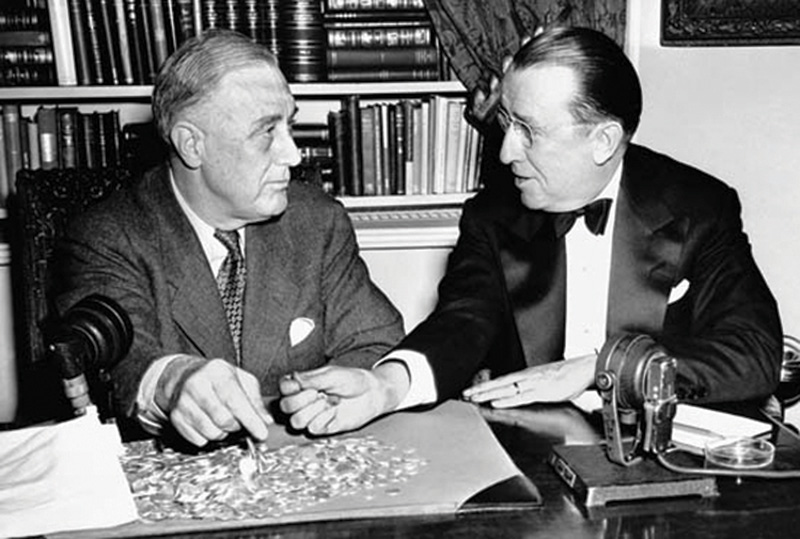
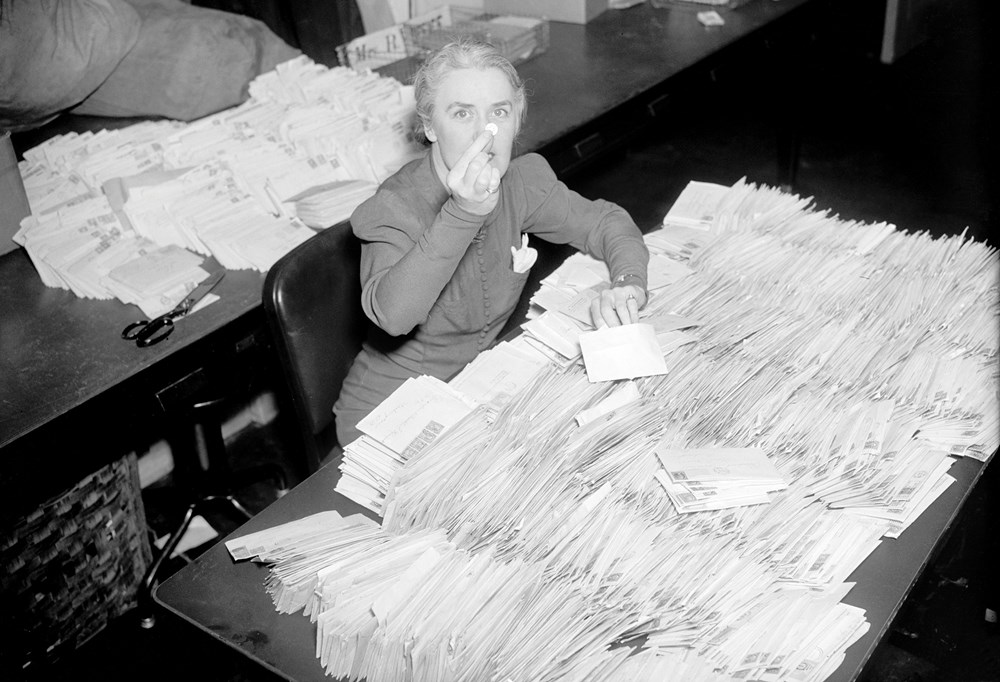
Because of his battle with polio, in 1938 FDR founded a non-profit organization to improve the health of babies and their mothers. Along with his friend Basil O’Connor, they financially supported the organization, and O’Connor became the foundation’s president, a role in which he served for more than three decades. It was originally named the "National Foundation for Infantile Paralysis." The well-known name "The March of Dimes" was originally a pun on the popular newsreel "The March of Time." The organization was extremely successful in funding the research and then distribution of Jonas Salk’s polio vaccine, which curtailed polio among the American public. Additionally, for FDR’s birthday on January 3, 1938, the American public donated 2.6 million dimes to the March of Dimes and mailed them to FDR at the White House.
As the effects of the Depression were ending in the United States, across the Atlantic Germany was invading Poland, and by 1940, France had also fallen. From our long-time allies, England and France, there was great pressure on America to enter the war. But while we offered aid, we resisted making a declaration of war. However, when the Japanese attacked Pearl Harbor, resulting in the loss of 2,403 American lives, the decision was made for the United States. The day after the Pearl Harbor attack, FDR rallied the country with his "Day That Will Live in Infamy" speech.
FDR was re-elected in 1936, 1940, and again in 1944. The American public wanted and needed his leadership and empathy. No popular Democrat wanted to challenge him, and the Republicans who ran against him during those three elections—Alf Landon, Wendell Willkie, and Thomas Dewey—all suffered huge defeats.
As America entered the war, Roosevelt’s voice on the radio was a constant companion for the American people. He calmed the public but also rallied them to help the boys fighting overseas. Roosevelt garnered public support for the war and encouraged and succeeded in having the American public conserve needed materials and resources, and in donating time and energy to the war effort. But as the war waged on, FDR’s health declined. He was diagnosed with hypertension, coronary artery disease, and finally, congestive heart failure.
He was never shown in newsreels seated in his wheelchair or being helped by aides. Although he couldn’t walk on his own, his aides often stood by his side holding him up. The media and the administration felt that they always wanted Roosevelt to display a strong and courageous face to the world.
By 1945, Roosevelt was very ill, and despite his health, he traveled to Yalta, in the Crimea, in the Soviet Union. The pictures of the big three participants—Joseph Stalin, Winston Churchill, and FDR—show a thin, old, and weak-looking Roosevelt, who was only 63. The travel and the worries about World War II certainly took their toll. Roosevelt died of a cerebral hemorrhage on April 12, 1945.
He was mourned by millions of people around the world, and, because of the war, his funeral was limited in scope, but the American people had lost their leader, their savior, their father figure.
The U.S. Congress went into action just three weeks later when Rep. James Morrison introduced a bill for a "Roosevelt Dime," given his relationship with the "March of Dimes." The Secretary of the Treasury announced that a new Roosevelt Dime would be designed and placed into circulation before the end of 1945.
The Chief Engraver of the United States Mint, John R. Sinnock, who had been in that position for 20 years, created a new design. He was aided by Gilroy Roberts, his assistant. The models were completed in October, and the Commission on Fine Arts (CFA) reviewed them.
The obverse, which displayed a bust of FDR, needed to be modified, but it was close to being acceptable. The CFA required that the reverse go through numerous design revisions and Sinnock complied. He finally submitted a reverse design that was similar to the accepted design with a torch, representing liberty, in the center of the reverse, an olive sprig representing peace on one side, and an oak sprig representing strength on the other.
But the finished product wasn’t without two minor controversies. Due to anti-Communist feelings right after World War II, when Sinnock added his initials "JS" to the obverse, the rumor circulated that the "JS" was actually an homage to Joseph Stalin, the Russian leader. That certainly wasn’t true and the Mint had to offer a response in order to quell that rumor. Additionally, Sinnock also had to dispel rumors that he copied a model of FDR’s head from an African-American sculptor, Selma Burke. He pointed to a medal of FDR that he had created years before as evidence.
Since then, the Roosevelt Dime has been minted continuously since 1946. Since mintages throughout the series are typically extremely high, tens to hundreds of millions, there are no real date/mintmark rarities. However, there are both error rarities and condition rarities. In addition, there are striking rarities that greatly affect the values.
Unlike other coins, Roosevelt dimes are quite often judged by the strength and depth of strike of the torch on the dime’s reverse. When the strike is strong, it is considered to have a "Full Torch" strike. To qualify as such, the bands of the torch should be fully struck and display a high degree of detail. There are two pairs of horizontal bands on the torch, with one pair on the upper part of the torch and the other on the lower part of the torch near the base.
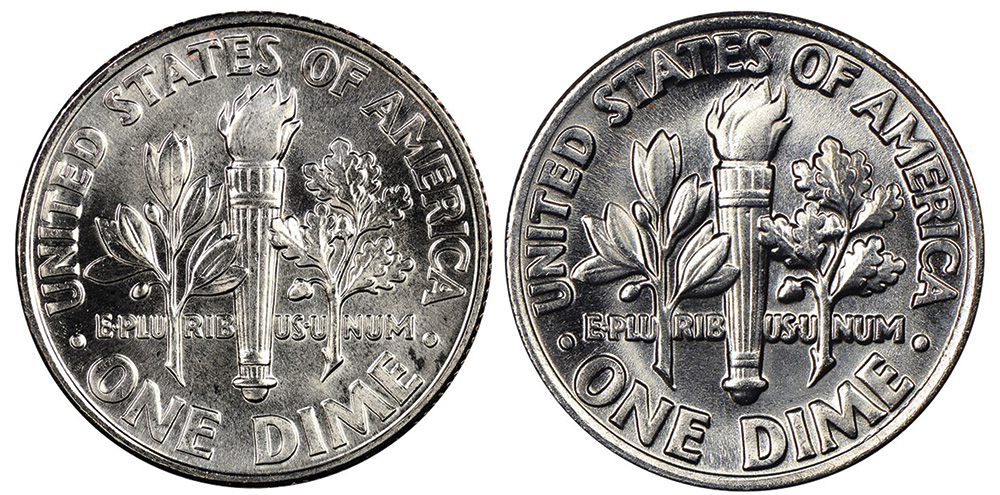
The horizontal bands must display a full separation from each other to be considered as having full bands. Two of the three major, third-party grading services, PCGS and NGC, began adding the torch designations to certified coins in 2003. However, PCGS uses the term Full Bands for grading Roosevelt dimes while NGC uses the term Full Torch for grading the same element of the design.
To obtain a PCGS Full Bands designation, both the upper and lower bands of the torch must display full separation, and the line dividing both pairs of bands should be unbroken. To obtain a Full Torch designation from NGC requires the same separation and distinction between the two pairs of bands, and the vertical lines of the torch must also display full separation. These designations indicate that the dime that you are considering is a more fully struck specimen and of higher quality. That is the reason these coins command a premium and are highly coveted.
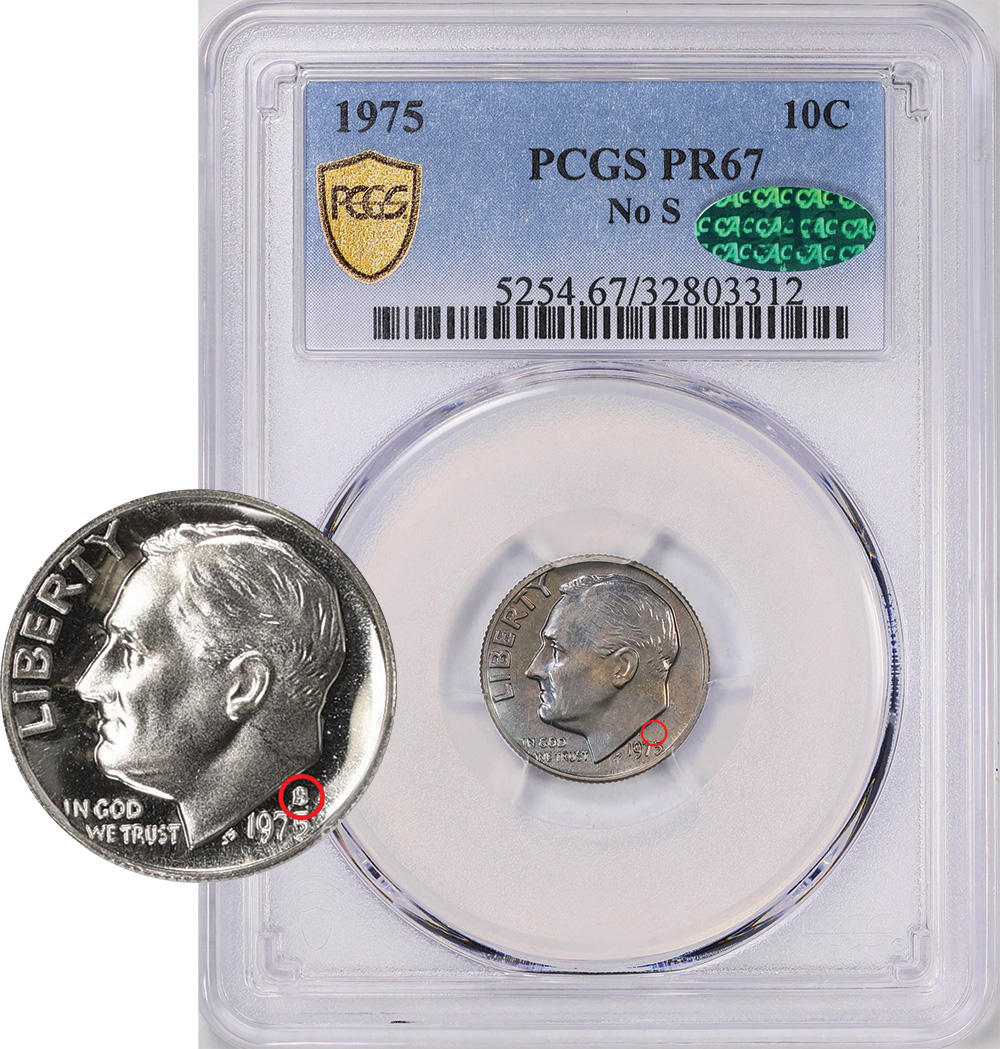
Some of the most expensive Roosevelt Dimes are either condition rarities or are error coins to some degree. The highest price ever paid (to date) for a Roosevelt Dime occurred on October 27, 2024, when a 1975 No S Proof Roosevelt Dime sold in a GreatCollections auction for $506,250 including the buyer’s premium. The coin was graded PCGS PR67 with a green CAC sticker attached to it. This coin is one of only two that are known to exist.
While we are discussing rarities, the next example is very likely unique. It is a Roosevelt Dime (undated) that was struck on a six-penny nail. It came straight out of the United States Mint and has been authenticated and sonically sealed in a PCGS holder. This was sold in a Heritage Auction in 2016, where the final hammer price was $43,200.
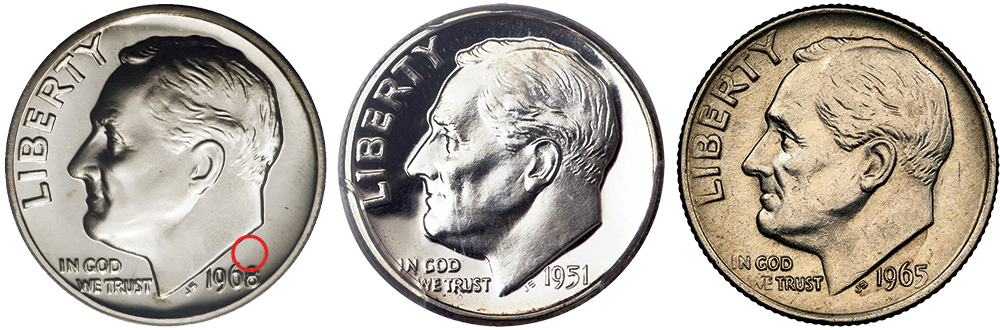
Another rare error Roosevelt Dime is the 1968 No S Dime graded by PCGS as PR68. This coin was sold by Heritage Auctions in 2005 for $32,200. There are less than two dozen of these coins that are known to exist and the first coins were discovered in June of 1968.
The next coin is a condition rarity example: a 1951 Roosevelt Dime in PCGS PR68 DCAM. Without the Deep Cameo designation this coin would be worth only $125. But this coin having the Deep Cameo designation makes it extremely rare and valuable. When it was sold in 2014, PCGS had only certified 9 coins that qualified as being designated as Deep Cameo. This particular coin has a jet-black field appearance against the highly frosted devices. It was also the highest-graded Deep Cameo example, which saw spirited bidding and a hammer price of $23,500.
Another coin worth mentioning is a 1965 Roosevelt Dime. 1965 was the first year of clad Roosevelt Dimes. Accordingly, it is an extremely common coin with a mintage of 1.6 billion. But this particular coin was not struck on a clad planchet. This coin was inadvertently struck on a left-over, 90% silver coin planchet. This coin is considered a "Transitional Alloy" example. These silver planchets were intended to be used until the remaining stock was exhausted. But those coins were to be struck using 1964-dated dies. Mistakenly, a small and unknown number of these silver planchets were struck with 1965-dated dies. When this coin was sold by Heritage Auctions in 2023, only 8 of these coins had been previously auctioned, making it truly rare. It sold for $14,400.
Overall, a Roosevelt Dime set is easily completed in most grades and if one ignores the error coins and the possible condition rarities, it is not a very expensive proposition. But it is a great series that has been struck continuously for nearly eighty years. Whether you are completing a set of some of the finest known coins or a set that might be a bit easier to complete you should only buy the coins in the grades that YOU like.
Related Stories (powered by Greysheet News)
View all news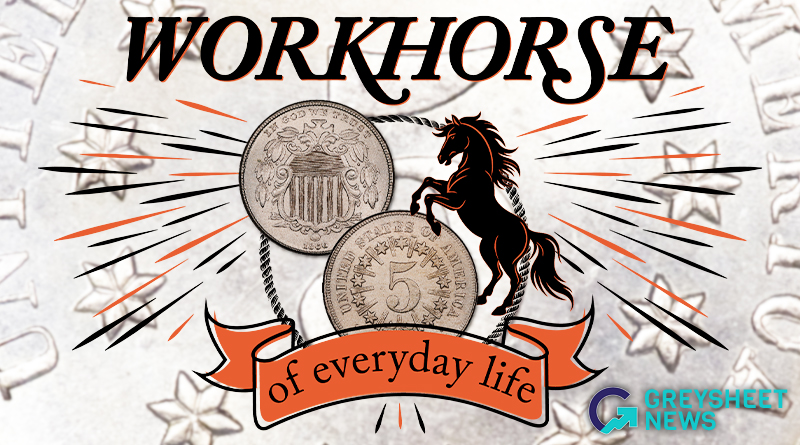
If you decide to put together a collection of shield nickels, none of these circulation dates are prohibitively rare.

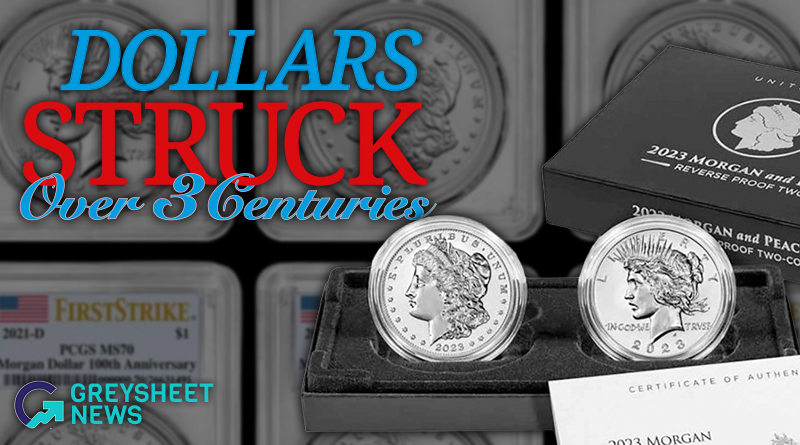
As dealers, collectors and investors all know, Morgan and Peace silver dollars are extremely popular American coins because of their history, legends, and silver content.
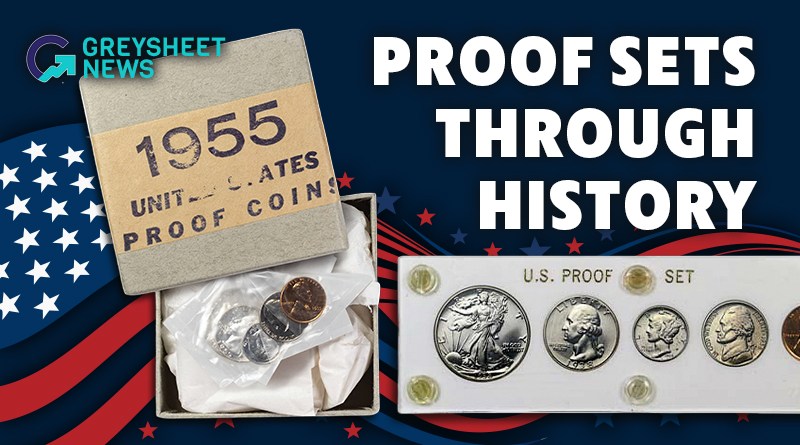
It is imperative that you research any Proof set before purchasing in order to determine the number of silver coins, the fineness, and the total weight of the silver content as they vary from year to year and from type of Proof set.
Please sign in or register to leave a comment.
Your identity will be restricted to first name/last initial, or a user ID you create.
Comment
Comments