


 Whitman Expo
The Walking Liberty Half Dollar: A Quantitative Strike Analysis
Although previous WL half studies have qualitatively defined the average strike characteristics of individual issues within the series, there has been no-to-little discussion of strike variability within an issue.
by CDN Publishing |
Published on August 19, 2025

Download the Greysheet app for access to pricing, news, events and your subscriptions.
Subscribe to Greysheet for the industry's most respected pricing and to read more articles just like this.
The Walking Liberty half dollar (1916–1947) series comprises 66 mint state and 7 proof issues. The series is considered one of the most beautiful designs and is widely collected within several popular PCGS and NGC registry subsets.
Unlike several other popular 20th century series that are designated as full steps (Jefferson nickels), full bands (Mercury dimes), full head (Standing Liberty quarters), or full bell line (Franklin half dollars), there is no strike designation for Walking Liberty halves by the grading services. Furthermore, it must be noted that the "full" designation by the grading services does not mean that a coin is fully struck (e.g. full step nickels can have 5 or 6 full steps, full band dimes can have rounded or flat bands and have sharp or weak peripheral detail, and full head quarters can have shield rivets that are strong or weak.) On average, a "full" designation on a grading service holder can represent a coin that ranges from 80 to 100% fully struck.
Studies of Walking Liberty (WL) half strike characteristics have focused on Liberty’s Head and Branch Hand on the obverse and the Eagle’s Trailing Leg on the reverse. For example, Anthony Swiatek (1983) states that "because of the existing situation concerning striking problems throughout the entire series… one must be reminded that each date be evaluated on its own merits." Dean Howe (1989) states that many issues are much scarcer than once believed, and some coins, which are considered common in uncirculated condition, are very scarce with full strikes. Bruce Fox (1993) says of the 66 mint state dates and mints in the series, 15 have major strike problems that are so prevalent that they may preclude the collector/investor from ever obtaining a fully struck example of those dates. David Bowers (2018) states that the hobby has no shorthand description of the quality of strike for WL half dollars. If such were to be adopted, FH&H for "Full Head and Hand" would probably answer much.
Although previous WL half studies have qualitatively defined the average strike characteristics of individual issues within the series, there has been no-to-little discussion of strike variability within an issue. Jeff Ambio (2008) has qualitatively discussed the similarities/differences in Head vs. Hand details. Any discussion of WL half strike characteristics must evaluate both the Head and Hand details, as some issues within the series are characterized with both strongly struck Head and Hand details, some issues have poorly struck Head and Hand details, other issues have strong Head and weak Hand details, while still others have weak Head and strong Head details. Focusing on just one aspect leads to an incomplete and inaccurate understanding of each issue.
Engineers and scientists commonly visualize 2-dimensional data in "heat maps" (e.g. temperature distribution within an engine cross section, or a bird species population density within a country.) WL half Head-Hand details lend itself to a 2-dimensional visualization "heat map" that I call the "strike map."
To develop such a map for each issue I started by examining several thousand mint state certified WL halves to quantify the range of head and hand strike details seen across the series. I then divided these details into 10 bins, with the strongest detail assigned a value of 10, and each progressively weaker strike characteristic as 9, 8… to a 1 for the weakest struck coins. Representative photos of the Head and Hand strike characteristics are shown in figures 1 and 2. Space prevents the full description and photo of each characteristic but is included in an upcoming 2026 book on the quantitative strike characteristic for all 73 issues in the series.
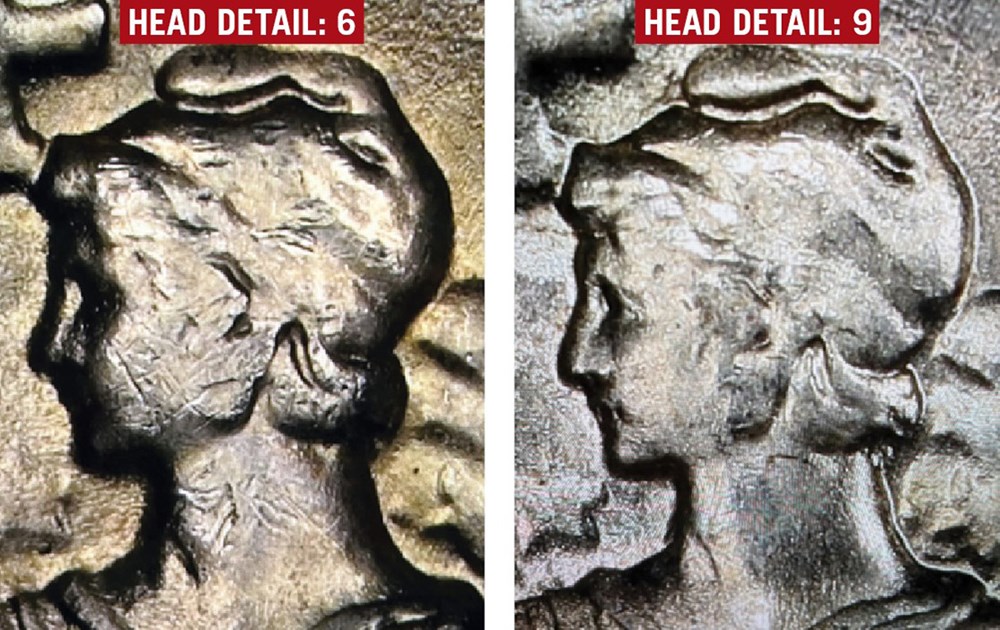
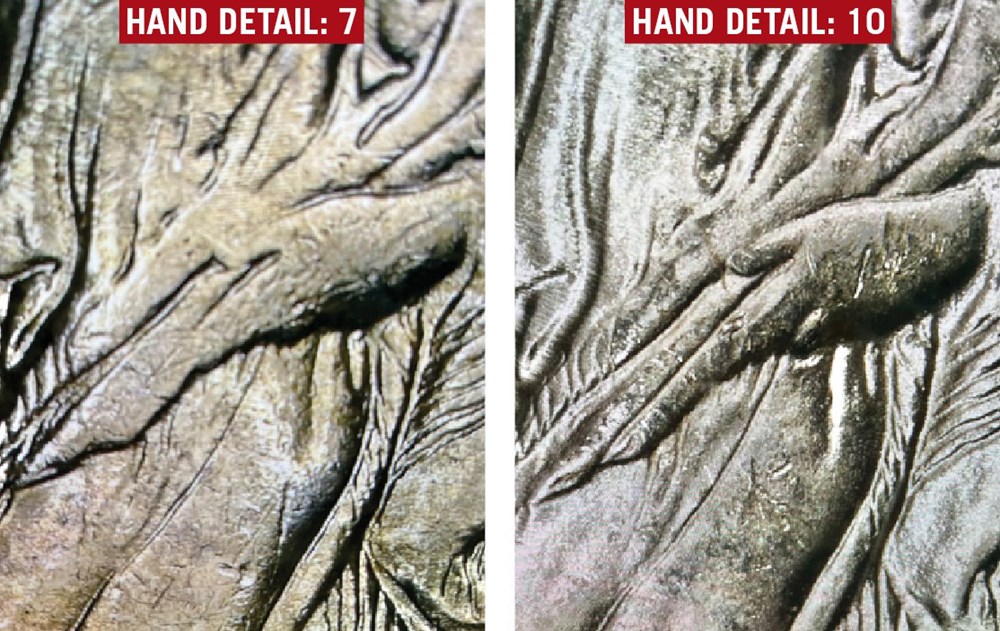
Once the 10- to 1 strike characteristics had been defined and photo documented, approximately 300 certified coins sold at Heritage, Stack’s Bowers and GreatCollections auctions in the last five years in grades MS65 and MS66 and higher are examined for each date and added to a master database.
Any re-auction appearances of a particular coin or a re-auctioned appearance of a coin that I identify as having been upgraded is only counted once in the database. The rationale for examining nominally 300 coins for each date (although not possible for some of the scarcer dates) is based on the point counting method used by scientists, especially geologists, where 300 random counts within a subsample of a larger population will statistically have a 95% confidence that any specific component within the population with an abundance of 1% or greater will be identified. Thus, constructing the strike map for any WL half date with approximately 300 coins examined will show both the strike variability within that issue and define, with 95% confidence, the strongest (1%) struck specimens within the entire population of the issue.
As two examples, I use 1941-P and 1941-S, two high-mintage dates with widely different head and hand characteristics, to illustrate how the strike map can quantitatively document strike variability within any date.
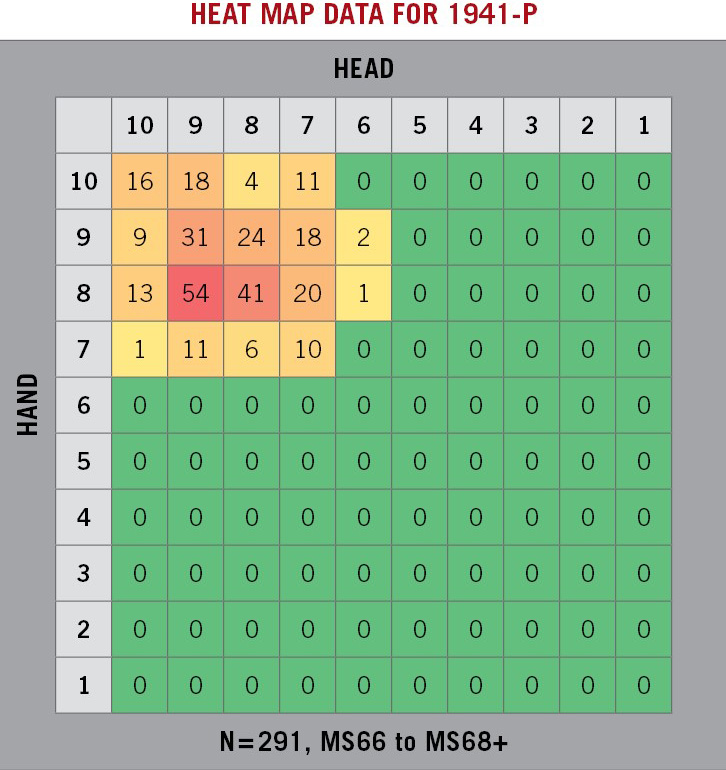
1941-P has a mintage of 24,192,000, a PCGS/NGC certified population of 8,200 (July 2025) MS66 or greater coins, and 291 of those certified coins comprise the strike map (Figure 3). Previous studies qualitatively agree that the 1941-P issue is well struck, but there had never been a quantitative assessment of the strike variability within the issue. The strike map shows that only 5% of the population is fully struck (i.e. head/hand 10/10). Focusing on only one strike characteristic shows that 12% of the population has fully struck head detail (but the hand detail for those coins can vary from a 10 to a 7). Alternatively, 16% of the population has fully struck hand detail (but the head detail for those coins can vary from a 10 to a 7). The weakest 3% of MS66 or greater coins in the issue have head and hand details of 7.
1941-S has a mintage of 8,098,000, a PCGS/NGC certified population of 1,570 MS66 or greater coins, and 188 of those certified coins comprise the strike map (Figure 4). Previous studies qualitatively agree that the 1941-S issue is poorly struck, but there had been no prior quantitative assessment of strike variability within the issue. The strike map shows that the strongest struck coins in the issue have head and hand details of 8 (comprising only 2% of the population). No coins exhibit hand details of 9 or 10, and only 0.5% have a head detail of 10, and 3% have a head detail of 9. The head-hand strikes for the issue are highly variable. For example, a coin with a 5-hand can have a head detail from 9 to 2. The weakest struck coins, even within the MS66 and MS67 population, have head and hand details of 2 to 3.
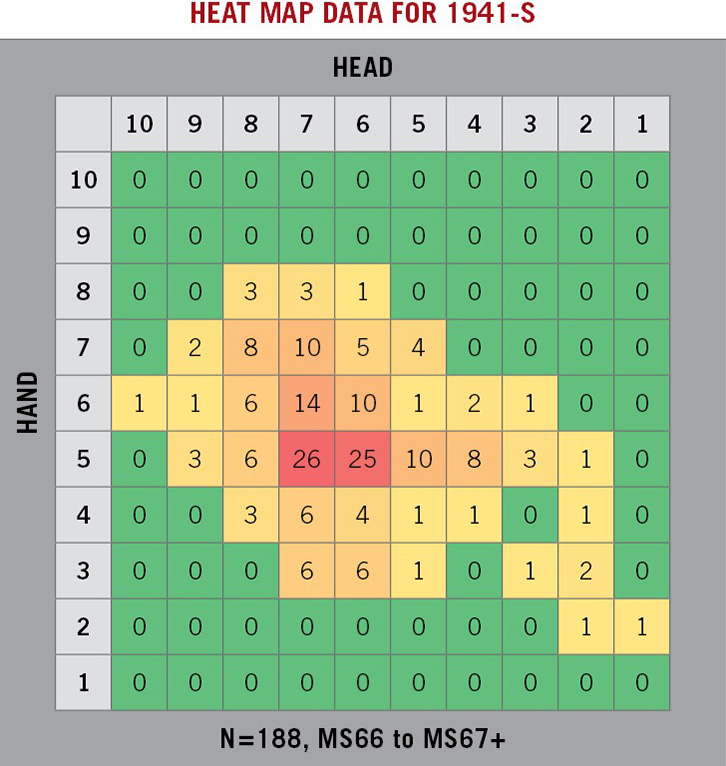
The strike of a Mint State coin remains unchanged from the time of its minting, whereas a coin’s grade can be affected by any number of post-minting events (e.g. bag marks, rubbing, scratches, luster, toning, overall eye-appeal). Given that the strike maps reflect the strike of the coins at the time of minting, a coin with 10/10 head/hand details is fully struck for a 1941-P. A coin with 8/8 head/hand details should be considered fully struck for a1941-S, as statistically no stronger struck coins were produced at the San Francisco mint that year.
Once the 73 strike maps are published any collector will be able to quantitatively assess the strike of any WL half in their collection or want list, cherry pick strike anomalies, and assemble a "fully struck" WL half set similar to the "full" sets in other 20th century series designated by the grading services.
By Glenn A. Jones, Contributor

Related Stories (powered by Greysheet News)
View all news
Greysheet Podcast Featuring John Feigenbaum, Ursula Kampmann, and David Guest


GACC Shows will be conducted again in the Chicago suburb of Rosemont, Illinois.
Greysheet Podcast Featuring John Feigenbaum, Hunter Hicks, and Stephen Yaffe
Please sign in or register to leave a comment.
Your identity will be restricted to first name/last initial, or a user ID you create.
Comment
Comments