


 Whitman Expo
Victoria “Gothic” Crowns Lead Heritage’s Great Britain & British Empire Coins Auction to $679,234
Auction led by two 1847 Gothic Crowns that bring combined $30,500.
by Heritage Auctions |
Published on November 19, 2026

Download the Greysheet app for access to pricing, news, events and your subscriptions.
Subscribe to Greensheet for the industry's most respected pricing and to read more articles just like this.
Two magnificent examples of Queen Victoria’s celebrated 1847 “Gothic” Crown led Heritage Auctions’ Nov. 9–10 Spotlight: Great Britain & British Empire World Coins Showcase Auction to $679,234, with the event achieving a 100% sell-through rate by both lots and value.
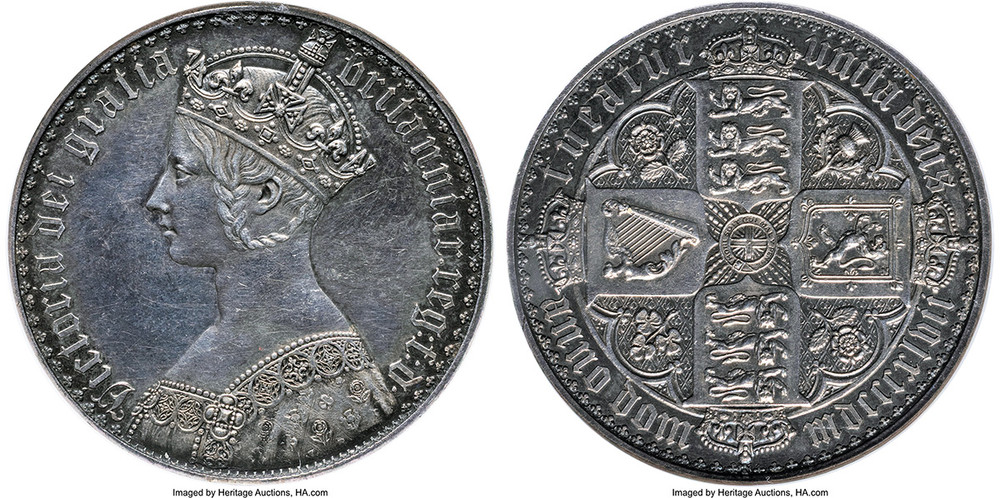
The auction brought together British and British Empire coinage spanning nearly a millennium, from a silver penny struck during the opening years of William the Conqueror’s reign to gold Proof issues commemorating significant moments in the history of the British Commonwealth. Leading the results was a Victoria Proof “Gothic” Crown 1847 PR60 NGC that realized $18,300, followed by another example of the beloved William Wyon design, a Victoria Proof “Gothic” Crown 1847 PR61 NGC, that brought $12,200.
The two Crowns, which combined for $30,500, underscored the enduring appeal of one of the most admired designs in British numismatics. Created by William Wyon, the Royal Mint engraver responsible for the famous 1839 “Una and the Lion” gold 5 Pounds, the Gothic Crown is celebrated for its intricate detailing, medieval-inspired artistry and distinctive portrait of the young queen.
The auction’s top result, the 1847 Proof Gothic Crown graded PR60 NGC, featured the plain-edge variety, a desirable version of an issue that has long attracted collectors of Victorian silver coinage. Its elaborate design and striking detail make it a significant example of Wyon’s artistic achievements, combining the craftsmanship of a celebrated engraver with the appeal of a limited original issue.
The second Gothic Crown, graded PR61 NGC, featured the UN DECIMO edge inscription and was struck in the first year of the type. With a recorded mintage of 8,000, the coin is a representative of a relatively brief series that remains among the most recognizable in British numismatics. Its balanced, dove-hued surfaces complement Wyon’s ornate design, adding to the appeal of a coin that continues to occupy an important place in collections of British crowns.
Another Victorian issue, a Victoria “Gothic” Florin 1887 MS64 NGC, achieved $7,320. Like the auction’s two leading Crowns, the Florin reflects the artistic influence of Wyon, whose crowned portrait of Victoria and Gothic lettering give the coin its distinctly medieval appearance. The reverse, designed by William Dyce, features crowned shields and floral emblems in an elaborate composition. The 1887 date carries additional significance because it marked the final year of the Gothic Florin design, which was replaced by the Jubilee coinage introduced to celebrate Victoria’s 50 years on the throne. The Florin also occupies an important place in British monetary history: introduced as an early step toward decimal currency, the denomination carried the inscription “one tenth of a pound,” linking its historical design to a forward-looking monetary experiment.
The auction also featured an important example of early English hammered coinage. A William I, the Conqueror Penny ND (1066-1068) XF45 NGC, struck at the Romney Mint under moneyer Wulfmær, brought $5,856. Dating to the opening years of William’s reign following the Norman Conquest of England, the silver penny represents one of the earliest coinage types issued under the new Norman king. Known as the Profile Left or Profile/Cross Fleury type, it features a crowned portrait of William holding a sceptre, while the reverse identifies the mint and moneyer responsible for its production.
A number of other British gold and silver coins also achieved strong results, including an Edward VII gold 5 Pounds 1902 MS61 ANACS that sold for $5,490. Issued to mark Edward VII’s coronation following Victoria’s long reign, the coin represents the only date of the 5 Pounds denomination produced during his reign. Its design pairs George William de Saulles’ portrait of the king with Benedetto Pistrucci’s celebrated depiction of St. George slaying the dragon.
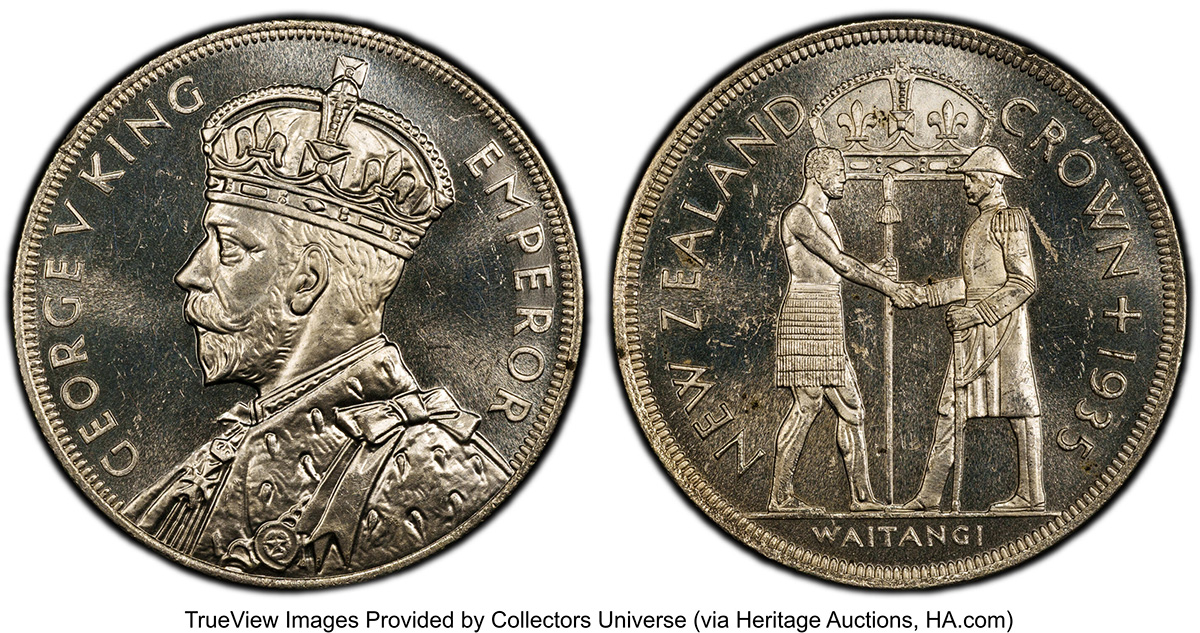
A George V “Treaty of Waitangi” Crown 1935 MS63 PCGS realized $5,368. Struck to commemorate the 1840 agreement between representatives of Britain and Māori chiefs in New Zealand, the coin features a reverse depicting Lieutenant-Governor William Hobson and Māori chief Tāmati Wāka Nene shaking hands beneath a crown. With a mintage of just 660 non-Proof examples and total production of 1,128 pieces including Proofs, the issue is an important rarity among New Zealand and British Commonwealth crowns.
Victorian coinage continued to feature prominently among the auction’s leading results. A Victoria Crown 1845 MS62 NGC brought $5,124. The coin, preserved in a commendable state of preservation, belongs to the brief Young Head Crown series of only four dates and features a youthful portrait of Victoria paired with a crowned shield within a laurel wreath.
Complete results can be found at HA.com/61668.

Related Stories (powered by Greysheet News)
View all news
Rare gilded bronze connects Hettie Anderson, Gilded Age New York and Theodore Roosevelt's coinage renaissance in a select 80-lot American Art Auction.


Auction house veteran joins Heritage to expand West Coast presence and strengthen services for professional fiduciary advisors.
Newly discovered 1867-S Half Eagle also shatters previous auction record in $10.665 million U.S. coins event; 1934 $10,000 Federal Reserve Note Leads $8.7 million U.S. currency auction.
Please sign in or register to leave a comment.
Your identity will be restricted to first name/last initial, or a user ID you create.
Comment
Comments