


 Whitman Expo
Weekly World Mint Coinage: November 12, 2026
New coins from France, Germany, and Switzerland.
by Michael Alexander |
Published on November 12, 2026


Download the Greysheet app for access to pricing, news, events and your subscriptions.

Subscribe to RQ: Red Book Quarterly for the industry's most respected pricing and to read more articles just like this.
France - Monnaie de Paris
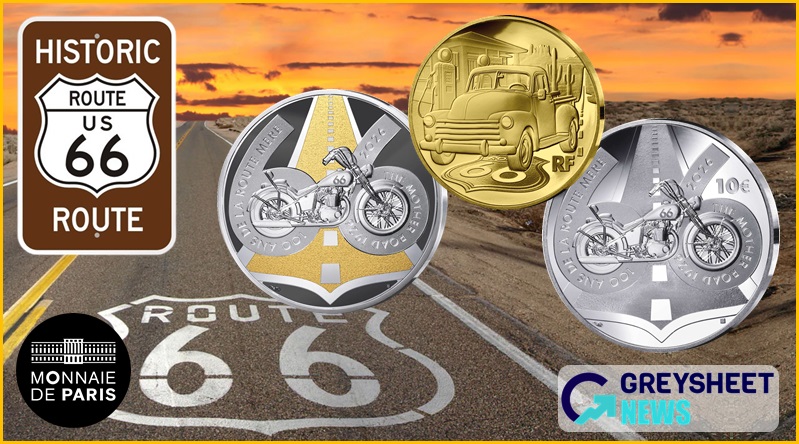
Gold and Silver Proof Coins Salute “Main Street of America”
The historical and cultural heritage of Route 66 serves as a symbol of freedom, travel, and the American pioneering spirit. That spirit is captured on the latest issue of the “Automobile History” series launched last year by Monnaie de Paris.
Route 66 is an iconic American highway spanning roughly 2,448 miles between Chicago, Illinois and Santa Monica, California. The dynamic project was heavily promoted by Tulsa businessman Cyrus Avery who is often called the ‘Father of Route 66’. It was in fact Avery who chose the double-digit name ‘66’ because he believed it was catchy and easy to remember.
It was after the Second World War that Route 66 became a symbol of American prosperity and social mobility. During this time, cafés, motels, fuel stations and tourist attractions sprang up along its route, giving rise to the culture of road trips and holidays on the open road.
From the 1960s onwards, construction of the modern interstate highway network gradually replaced Route 66. It never lost its attraction and admiration of dedicated drivers keen to travel the open spaces and view up-close the beautiful scenery. Today, under the name “Historic Route 66”, it remains a symbol of traditional America and its history attracting travellers from all over the world who come to discover its varied landscapes, its iconic towns, its road heritage as well as experiencing the spirit of freedom it embodies.
Designed by Joaquin Jimenez, General Engraver of Monnaie de Paris, the obverse of the coin features several iconic elements of Route 66. In the background are the mountains of Amarillo, Texas, evoking the wide open spaces crossed by this legendary route. A typical gas station recalls the many stops that once dotted the travellers' route. The distinctive Route 66 interstate sign is recreated and shown on the tarmac and remains one of the most recognisable symbols of this legendary road. A car is in the centre of the design, paying tribute to the millions of travellers who have travelled along Route 66 over decades of generations. The initials RF (République Française) are shown just near the rear wheel of the truck and complete the design. The reverse pays tribute to another way of travelling along this legendary route, and that is by the motorcycle which over time has become one of the symbols of travelling on Route 66. The number 66 is incorporated into the design itself and forms the motorcycle’s wheels, creating a direct link to the famous road. The inscription along the first numeral 100 ANS DE LA ROUTE MÈRE recalls the historical and cultural significance of this route. The second numeral includes the text THE MOTHER ROAD 1926 2026 along its form and highlighting the centenary of this legendary road. The denomination 10€ is placed just to the upper right.
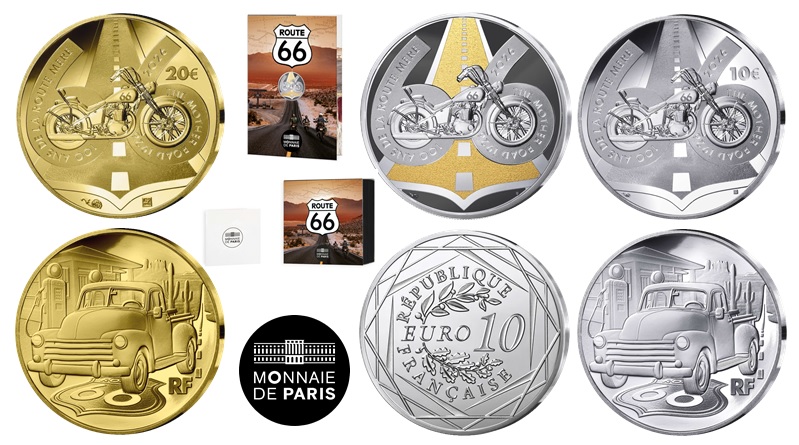
| Denomination | Metal | Weight | Diameter | Quality | Mintage Limit |
| 10 Euro | .900 Silver | 13 g. | 31 mm. | BU & Colour | 10,000 |
| 10 Euro | .999 Silver | 22.2 g. | 37 mm. | Proof | 3,000 |
| 20 Euro | .999 Gold | 3.1 g. | 15 mm. | Proof | 1,000 |
| 200 Euro | .999 Gold | 31.1 g. | 37 mm. | Proof | 250 |
Each coin in the Route 66 gold and silver collector Proof range is encapsulated and presented in a custom case accompanied with a certificate of authenticity. The BU silver coin is presented in a blister-type card folder which includes text and illustrations. For additional information, visit the e-webshop of the Monnaie de Paris.
Germany - State Mint of Stuttgart
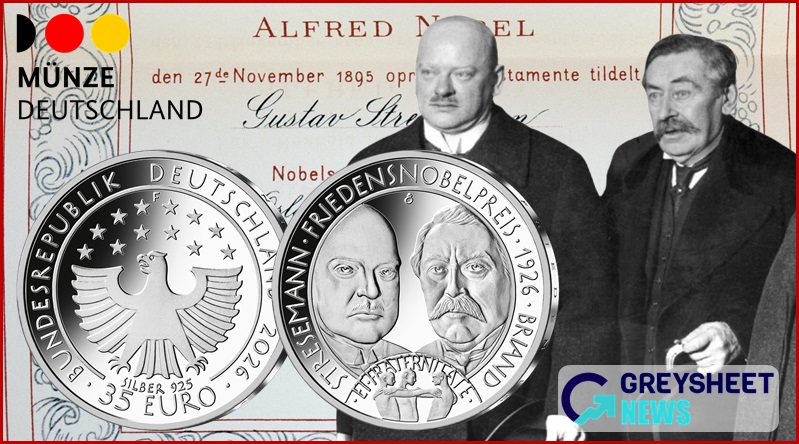
Silver Proof Coins Honour Nobel Peace Prize Centenary
This year, Germany marks the centenary anniversary of awarding of the Nobel Peace Prize to both a German and French recipient in the spirit of reconciliation. It was in 1926 that Gustav Stresemann and Aristide Briand jointly received the honor for their outstanding efforts toward Franco-German understanding after the First World War.
Stresemann and Briand had taken a decisive step toward stabilising Europe with the Treaty of Locarno, signed and ratified in 1925. Both politicians recognised that lasting peace could only be achieved through dialogue, trust, and cooperation. The prize honours their courage in overcoming past enmities and creating a new foundation for European cooperation.
Gustav Stresemann was the German Foreign Minister, and a former Chancellor of the German Weimar Republic, successor to the German Imperial Reich while Aristide Briand was the French Foreign Minister and also a former Prime Minister. Their diplomacy led to a Franco-German reconciliation after World War I, both countries still resentful from the results of the Franco-Prussian war of 1870-71. This was a major conflict between the Second French Empire and the Prussian-led German states which resulted in a decisive German victory and the unification of the German States under the crown of Prussia.
Unfortunately, the peace so hard-fought for and that many believed would be permanent unravelled swiftly with the election of the National Socialists in Germany and the rise of Adolph Hitler who began to demand reverses in terms of land and armaments negotiated through the Locarno treaties. Demands for territory in Czechoslovakia with a German majority as well as unification with Austria in 1938 ultimately led to the invasion of Poland in September 1939, triggering defence pacts between Great Britain, France and Poland, resulting in what would become World War II.
Four years after the formal end of fighting, the Council of Europe was established in May 1949 by the signing of the Treaty of London. It is today Europe's oldest political organisation, born from the collective post-war efforts to protect democracy, uphold the rule of law and ensure that the atrocities of World War II would never be repeated.
The silver Proof coins are produced by the Staatliche Münze Baden-Württemberg at their facilities in Stuttgart on behalf of the German Federal Finance Ministry and designed by Ulf Schüler. The obverse features images of the statesmen Gustav Stresemann shown on the left and Aristide Briand on the right, skillfully modelled and placed at the centre gazing intently at the viewer. The depiction of the two men standing shoulder to shoulder and the surrounding inscription closely replicate the original medal awarded on the occasion. A portion of the Nobel Peace Prize medal is positioned between the two images at the bottom, vividly illustrating the connection between the honourees and the occasion. The primary design is surrounded by the commemorative text along the rim which reads STRESEMANN · FRIEDENSNOBELPREIS · 1926 · BRIAND. The reverse depicts a stylised eagle which is centred and positioned towards the lower half together with a collection of 12 five-pointed stars placed above the eagle representing the European Union. The text BUNDESREPUBLIK DEUTSCHLAND 2026 is placed around the primary design along the rim and the denomination 35 EURO is shown just below. Above the denomination is the coin’s fineness with the text SILBER 925 (Proof) or, SILBER 500 (UNC). The mintmark F denoting the Baden-Württemberg State Mint, Stuttgart is found above the collection of stars. The smooth edge of the coins include the incused lettering FRIEDEN IN EUROPA - PAIX EN EUROPE.
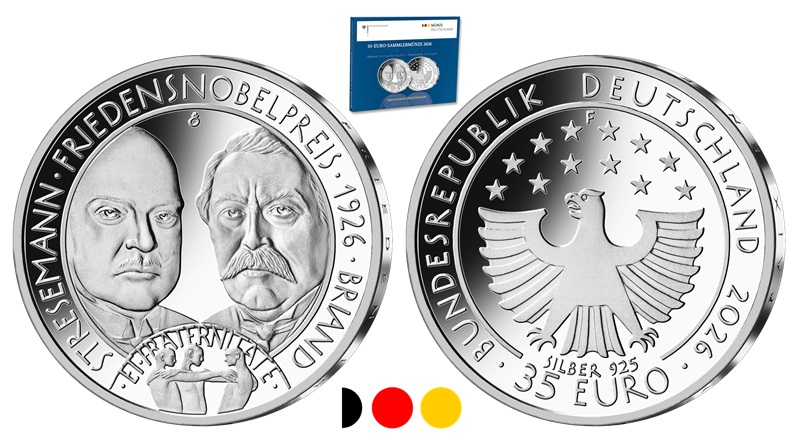
| Denomination | Metal | Weight | Diameter | Quality | Mintage Limit |
| 35 Euro | .500 Silver | 17 g. | 32.5 mm. | UNC | 600,000 |
| 35 Euro | .925 Silver | 18 g. | 32.5 mm. | Proof | 63,000 |
The Uncirculated coins are available for their face value at leading commercial banks, post office counters and Deutsche Bundesbank branches. The Proof-quality collector’s edition is encapsulated and included in a standard presentation folder. For additional information, visit the e-webshop of Munze Deutschland, official distributors.
Switzerland – Federal Mint Swissmint
Silver Commemorative Coins Feature Symbolic Journey of the History of Aviation
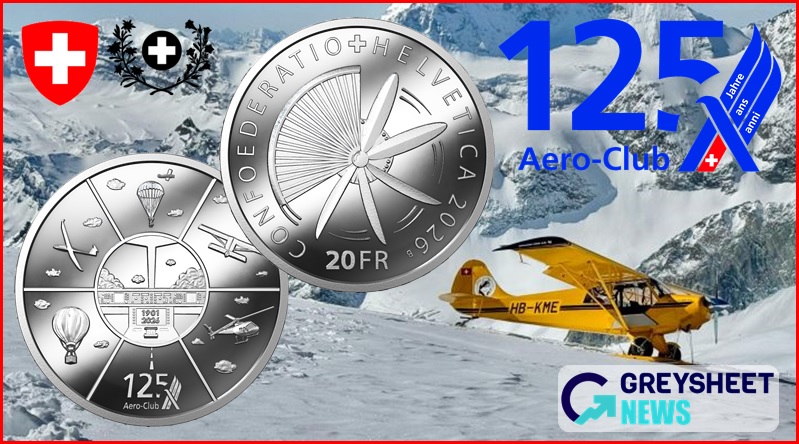
Federal Mint Swissmint offers the second collector coins in the “Pioneers of Swiss Aviation” series which was launched in 2025. This issue marks the 125th anniversary of the Aero Club of Switzerland – AeCS, the national umbrella organisation for general aviation, light aviation, and air sports in Switzerland which founded in Bern in 1901.
The Aero-Club of Switzerland is today based in Luzern and with an active membership of 23,000 pilots, amongst some 370 local groups in eight federations. The club also oversees activities such as ballooning, aeromodelling, sailplaning, power-flying, parachuting, experimental and homebuilt aircrafts (microlight and helicopter) across 40 regional aero-clubs.
This organisation has overseen countless technological developments, challenges and successes since its foundation, and has remained diligent in representing the interests of air sports and their athletes as they have evolved over the decades. They remain focused on advocating for the needs of its athletes from grassroots level to international competitors. The club’s core missions and affiliations include representing Swiss light aviation interests regarding airspace, infrastructure, and politics, and acts as the national sporting authority for air sports.
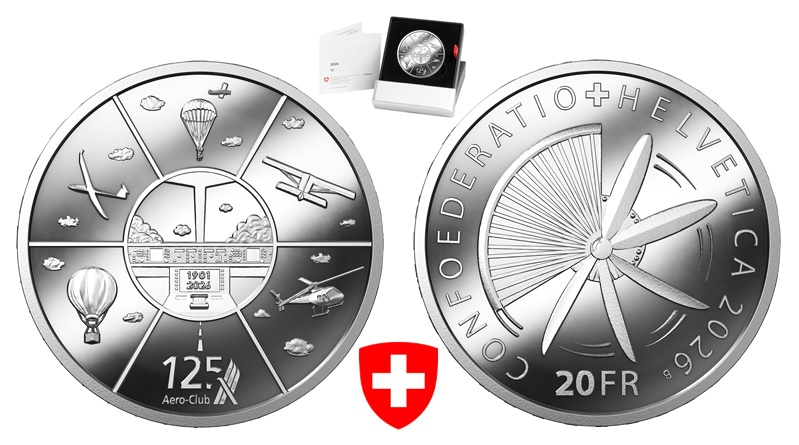
The coin’s design offers a symbolic journey through the history of aviation. The obverse features the cockpit controls of an airplane centred along with the commemorative years 1901 and 2026 shown on the instrument panel. Surrounding the cockpit, the history of aviation unfolds in segments from ballooning at the lower left, gliding in the next segment followed by parachuting and next is a representation of early aeroplanes, and ending with the helicopter. Below the controls is the Aero Club of Switzerland’s logo anniversary that includes the numeral 125. The reverse, common to all of the coins in the series, depicts a stylised propeller blade in motion centred and which references advances in technology up to the present day and which the propeller transforms into a turbine. The inscription CONFOEDERATIO HELVETICA 2026 is placed along the rim. The nominal value of 20 FR is shown below the primary design and the letter B representing the Bern Mint is placed just after the year. The coins include the raised edge inscription in Latin DOMINUS PROVIDEBIT (The Lord will provide) along with 13 five-pointed stars.
| Denomination | Metal | Weight | Diameter | Quality | Mintage Limit |
| 20 Francs | 999.9 Silver | 20 g. | 33 mm. | BU | 8,000 |
| 20 Francs | 999.9 Silver | 20 g. | 33 mm. | Proof | 3,500 |
The BU coin is available encapsulated, the Proof versions are encapsulated and presented in a custom case – both versions are accompanied with a numbered certificate of authenticity. For additional information, visit the e-webshop of the Swiss Mint / Special Coins.
Related Stories (powered by Greysheet News)
View all news
New coins from Austria, Hungary, and the United Kingdom.


New coins from Australia, China, and the Netherlands.
New coins from the Falkland Islands, Gibraltar, and Malta.
Please sign in or register to leave a comment.
Your identity will be restricted to first name/last initial, or a user ID you create.
Comment
Comments