


 Whitman Expo
Weekly World Mint Coinage: November 26, 2026
New coins from Belgium, Canada, and Poland.
by Michael Alexander |
Published on November 26, 2026


Download the Greysheet app for access to pricing, news, events and your subscriptions.

Subscribe to RQ: Red Book Quarterly for the industry's most respected pricing and to read more articles just like this.
Belgium – Royal Belgian Mint
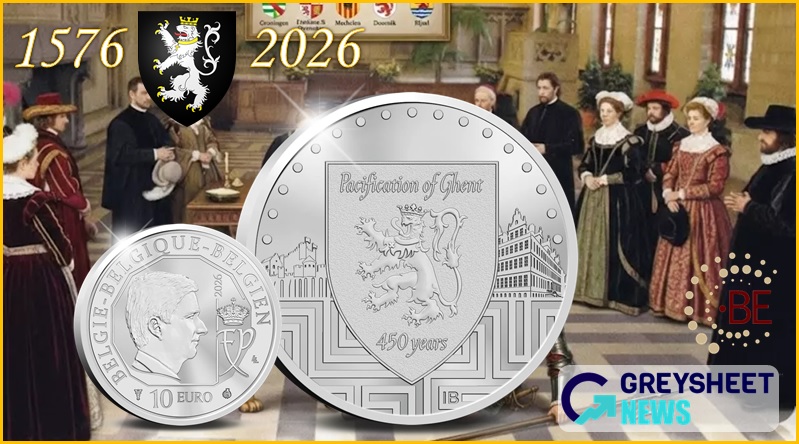
Silver Proof Coins Remember Historic Peace Treaty
This year marks the 450th anniversary of the Pacification of Ghent treaty of 1576 signed by the 17 rebellious provinces of the Netherlands. Initially borne out of the violence known as the Spanish Fury, this arose as a result of the Spanish occupation of the Netherlands.
The alliance was signed on the 8th November 1576 by the northern and southern provinces of the Habsburg Netherlands. This historic agreement was concluded in the Town Hall of Ghent and marked a turning point in the struggle against Spanish rule, laying the foundations for religious tolerance and political cooperation.
By January 1579, the region split into the Union of Arras consisting of the Southern Catholic provinces seeking reconciliation with Spain and the Union of Utrecht – present-day Netherlands which was made up by the Northern provinces who continued their revolt under the leadership of Prince William I of Orange. The southern provinces would eventually become modern-day Belgium.
The Silver Proof coins are produced by the Royal Dutch Mint at their facilities in Houten, Netherlands in association with the Royal Belgian Mint and are designed by Iris Bruijns. The reverse features the coat of arms of Ghent with the white rampant lion at its centre. The commemorative text on the shield reads PACIFICATION OF GHENT in English above the lion with the additional text 450 YEARS placed below. The shield is flanked by images of the medieval Gravensteen castle on the left and Ghent Town Hall on the right. The labyrinth-shaped floor pattern of the Ghent Town Hall is reproduced on the lower part of the coin. At the top, 17 rivets are visible, referring to the 17 united regions. The obverse includes an effigy of King Philip designed by Royal Belgian Mint artisan Luc Luycx, facing right along with his crowned monogram placed to the right and text surrounding the likeness of the King which reads BELGIE – BELGIQUE – BELGIEN representing the official three languages of Belgium. The denomination 10 EURO is placed below the primary design and the year of issue 2026 is shown in a vertical direction.
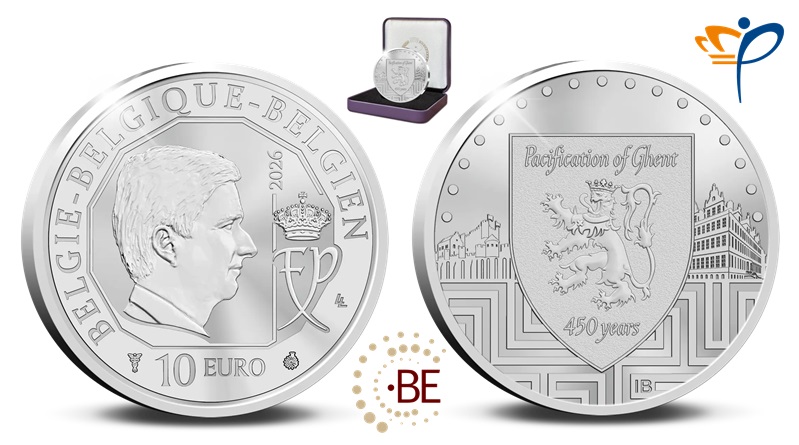
| Denomination | Metal | Weight | Diameter | Quality | Mintage Limit |
| 10 Euro | .999 Silver | 15.5 g. | 35 mm. | Proof | 5,000 |
Each Proof coin is encapsulated and presented in a custom case accompanied by a certificate of authenticity. This is the first €10 coin struck in a half ounce of .999 silver and with a larger diameter than previous coins of the same denomination. For additional information, visit the e-webshop of the Royal Belgian Mint.
Canada - Royal Canadian Mint
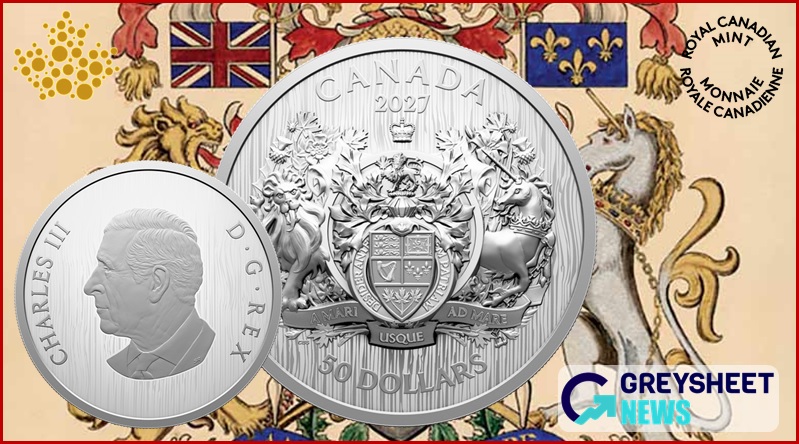
Large-Size Silver Ultra High Relief Proof Coins Feature Striking Coat of Arms
As a follow-up of 2025’s high-relief Heraldic Bear and 2026’s Heraldic Lion, this 2027-dated coin combines the elegance of Canadian heraldry with maximum relief, boldly depicting familiar heraldic elements and elevating them both literally and figuratively into a more dimensional and dramatic form.
The design presents a high-relief reworking of the Arms of Canada, rendered in a stylised manner to allow for a richer, more ornate composition. Dedicated Canadian coin and banknote collectors will know the crest is part of the design on all banknote denominations and is also the featured reverse design on circulation-type 50 cent coins since 1937.
At the base of Canada’s Coat of Arms is a garland of floral emblems - the English rose, the Scottish thistle, the Irish shamrock and the French lily with a scroll bearing the motto A MARI USQUE AD MARE (From sea to sea). At the centre is the shield, its upper quadrants feature the three lions of England, the lion of Scotland, the Irish harp of Tara and the fleurs-de-lis of Royal France, while the bottom portion features a sprig of three maple leaves. The supporters are based on those of the Royal Arms of the United Kingdom. To the left of the shield, the lion of England holds the Royal Union Flag, while on the right, the unicorn of Scotland carries the flag of Royal France. Above the shield is the royal helmet draped with mantling. Atop the royal helmet is the crest set on a wreath of twisted cloth, and is comprised of a crowned lion holding a maple leaf in its right paw. Above the crest is the imperial crown that represents the monarch as Canada's Head of State.
The reverse is minted utilising Ultra High Relief (UHR) and Extraordinarily High Relief (EHR) which work together to create a striking ascent from edge to centre. The reverse of the coin is designed by renowned Canadian heraldic artist Cathy Bursey-Sabourin, who was at the time Fraser Herald at the Canadian Heraldic Authority. The lion and unicorn supporters, as well as the floral elements, have been artfully modified to fill the space and guide the viewer’s eye toward the centre, which features the shield, helmet, mantling, crest and motto annulus from the Order of Canada DESIDERANTES MELIOREM PATRIAM (They desire a better country). Above the primary design is the text CANADA along with the year of authorisation, 2027 and below, the denomination 50 DOLLARS. The obverse features an effigy of King Charles III created by Canadian artist Steven Rosati. The legend CHARLES III D · G · REX is placed on either side of the effigy. Both obverse and reverse feature an engraved woodgrain field pattern serving as a visual connection to the natural world that has inspired many of Canada’s identifying emblems.
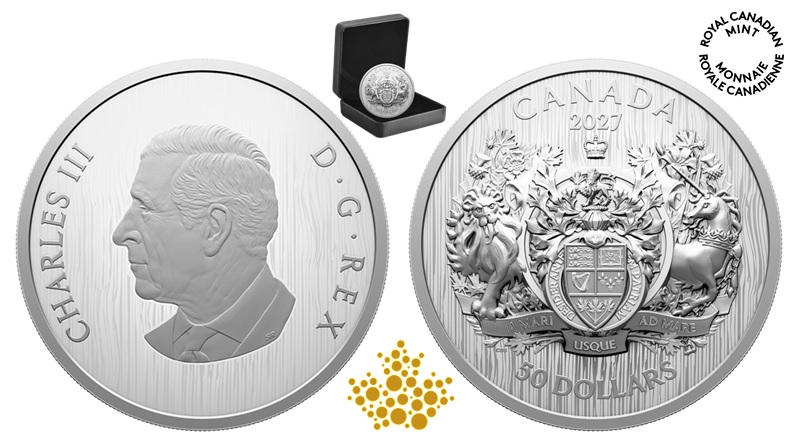
| Denomination | Metal | Weight | Diameter | Quality | Mintage Limit |
| 50 Dollars | 99.99 Silver | 78 g. | 50 mm. | UHR Proof | 2,000 |
Each Ultra High Relief Proof coin is encapsulated and presented in a custom case to accommodate the large diameter and weight, accompanied by a certificate of authenticity. For additional information, visit the e-webshop of the Royal Canadian Mint.
Poland - Mint of Poland
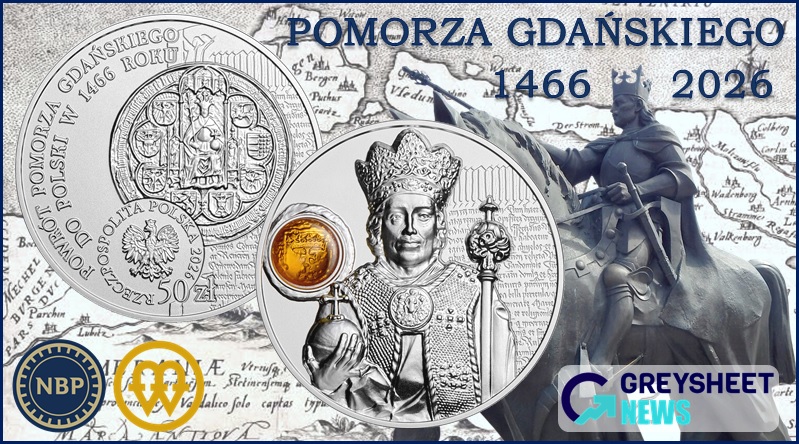
High Relief Coins Honour the Return of Historic Lands
The Thirteen Years’ War between the Kingdom of Poland and the Teutonic Order came to an end with a peace treaty signed in Toruń on the 19th October 1466. Prior to the treaty of peace, military operations commenced with both wins and losses on the battlefield, back and forth but, Poland’s advantage resulted from its significant political, economic, and military potential, which outweighed the Teutonic strength. Despite defeats and domestic crises within the state that were difficult to overcome, King Casimir Jagiellon never doubted victory and pursued the policy of annexing Pomerania from Prussia with unwavering determination.
At a ceremonial sitting of the Royal Council, the King issued an act of unilateral incorporation of the entire province to the Polish state and Crown. Shortly after this decision, King Casimir Jagiellon made a triumphant entry into previously held Prussian territory at the head of his troops along with a large contingent of courtiers.
The initial successes, the mass rallying to the royal banners, and the joyful reception of the king of Poland wherever he appeared were somewhat mitigated by the defeat at the Battle of Chojnice in the autumn of the first year of the war. The ultimate triumph was to come only years later, when Gdańsk Pomerania, Warmia, and the Chełmno and Michałowo Lands came under the rule of the king of Poland once more. The recovery of Gdańsk Pomerania and the remaining Prussian lands was of immense importance to the Crown. It restored control over the mouth of the Vistula and gave access to the Baltic Sea, which strengthened the economic position of the state and brought an end to a conflict with the Teutonic Order that had lasted for over a century and a half.
The large-size silver BU coins are produced in high relief by the Mint of Poland at their facilities in Warsaw on behalf of the National Bank and designed by Dobrochna Surajewska The obverse of the coin features a detailed depiction of King Casimir Jagiellon holding an orb in his right hand and a sceptre in his left. The design is inspired by an image of the King featured on his sarcophagus located in Wawel Cathedral. In the background to the right includes an image of detail of the first page of the Second Peace treaty of Toruń and on the left is coat of arms of Gdańsk which is depicted according to the 1457 seal impression, featuring a decorative amber element. The reverse of the coin depicts the seal of majesty of King Casimir Jagiellon off-centre to the right set against a detail of the first page of the Second Peace of Toruń in the background. The detail of the image of the original document of the Second Peace of Toruń from 1466 is now housed in the Central Archives of Historical Records in Warsaw. Along the rim to the left half is the text POWRÓT POMORZA GDAŃSKIEGO / DO POLSKI W 1466 ROKU (The return of Gdańsk Pomerania / To Poland in 1466) Below the royal seal is Poland’s national symbol, the crowned Eagle which is encircled and surrounded by the text RZECZPOSPOLITA POLSKA 2026 and the denomination 50 ZŁ.
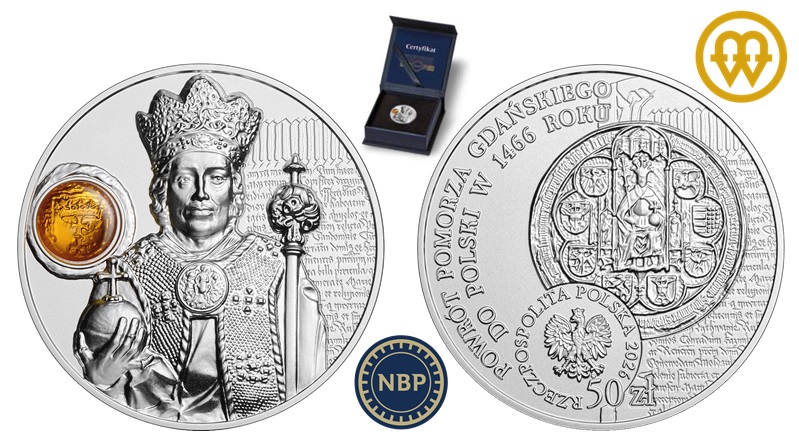
| Denomination | Metal | Weight | Diameter | Quality | Mintage Limit |
| 50 Zlotych | .999 Silver | 62.2 g. | 45 mm. | BU & Inlay | 4,000 |
Each high-relief BU strike coins is encapsulated and presented in a custom heavy-gauge card case to accommodate their large diameter and weight, accompanied by a certificate of authenticity. For additional information, please visit the e-webshop of the National Bank of Poland.
Related Stories (powered by Greysheet News)
View all news
New coins from Australia, Croatia, and Hungary.


New coins from France, Germany, and Switzerland.

New coins from Austria, Hungary, and the United Kingdom.
Please sign in or register to leave a comment.
Your identity will be restricted to first name/last initial, or a user ID you create.
Comment
Comments