


 Whitman Expo
Weekly World Mint Coinage: November 5, 2026
New coins from Austria, Hungary, and the United Kingdom.
by Michael Alexander |
Published on November 5, 2026

Download the Greysheet app for access to pricing, news, events and your subscriptions.

Subscribe to RQ: Red Book Quarterly for the industry's most respected pricing and to read more articles just like this.
Austria - Austrian Mint
Proof Gold Coins Launch Myths, Treasures and Legends Collector Series
The Austrian Mint now offers Proof gold coins which focus on fascinating insights into the Imperial House of Austria and the religious and mythical worldviews that shaped it. The first coin in the Myths, Treasures and Legends series draws on the priceless legacy of 600 years of Habsburg rule. Each coin in the series will feature high-quality reproduction designs focusing on the exceptional treasures, inspired by priceless works of art preserved in the Imperial Treasury in Vienna.
The theme brings together objects that beautifully unite the earthly and the divine. The first coin highlights symbols of the divine which deserves pride of place in the new collection. It depicts relics that, during the Middle Ages and beyond, were believed to have come into contact with the blood of Christ.
For two millennia, scholars and theologians have been fascinated by the search for the Holy Grail, The Blood of Christ. The Holy Lance has been interpreted in various ways over the centuries and, by the 13th century, it had come to be identified with the lance of the soldier Longinus, who is said to have inflicted Christ's fatal wound. Believed to have been stained with Christ's blood, the lance was long regarded as a symbol of imperial authority and ranked among the foremost Imperial Regalia. Its miraculous powers were even thought to have brought about victories in battle. Another relic associated with Christ's Passion is a collection of fragments of the True Cross dating from after 1350 and were believed to be stained with Christ's blood. Across the centuries, these precious testaments to Christian devotion have retained their aura of the divine and more importantly, preserved imperial treasures currently on display at the Hofburg Palace in Vienna.
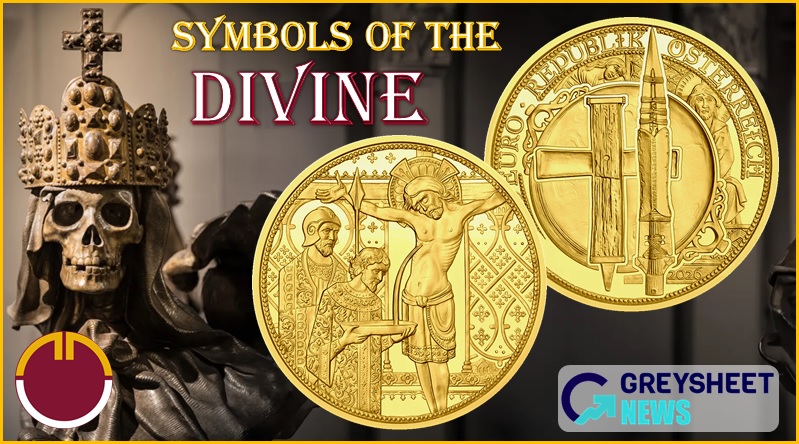
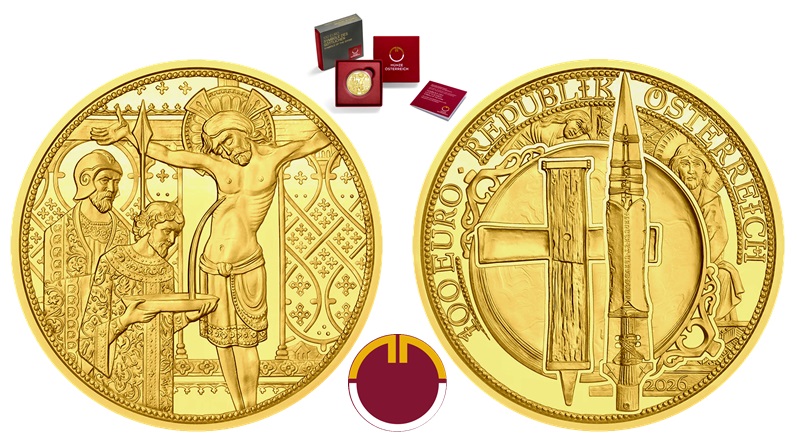
Designed by Helmut Andexlinger, Rebecca Koini and Kathrin Kuntner, the obverse depicts these renowned Christian relics. The Holy Lance contains at its centre, a metal pin believed to be one of the nails used to nail Christ to the Cross. Behind it are the Relics of the True Cross. Behind them is the 4th century agate bowl, carved from a single block of stone, including its handles. This extraordinary masterpiece was revered as the Holy Grail. Along the rim surrounding the primary design is the stylised text 100 EURO · REPUBLIK OSTERREICH with the year of issue, 2026 placed just to the lower right. The reverse depicts the crucified Christ as blood flows from his side and is caught in a bowl. To the left stands the soldier Longinus, holding the lance with which he is said to have inflicted the wound.
| Denomination | Metal | Weight | Diameter | Quality | Maximum Mintage |
| 100 Euro | .986 Gold | 15.78 g. | 30 mm. | Proof | 20,000 |
Each Proof-quality silver coin is encapsulated and presented in a heavy-gauge card case complete with a numbered certificate of authenticity and protective slipcase. An elegant, high-quality oak custom case featuring a metal plaque set into the lid is available as a separate purchase. For additional information, please visit the e-webshop of the Austrian Mint.
Hungary – Mint of Hungary
Silver Proof Coins Released to Observe 70th Anniversary of Fight for Freedom
Hungary marks the 70th anniversary of the 1956 Hungarian Revolution and Freedom Fight, a pivoting milestone in the country’s struggle for its democratic traditions and territorial integrity. The spontaneous revolt was inspired by a speech given by Soviet leader Nikita Khrushchev who denounced Joseph Stalin in early 1956, sparking hopes for reform across Eastern Europe.
Students and workers gathered in Budapest to demand free elections, the withdrawal of Soviet troops, and reformist leadership. Hundreds of thousands of Hungarians also rallied around the Hungarian flag but with one important difference, the communist insignia added to the national banner in the centre, had been cut away. This important alternation would leave a very large distinctive hole which essentially itself became a symbol of anti-communism and of the revolt itself.
Protesters also called for reformist leader and former Prime Minister Imre Nagy to head a government once again, which happened the next day of the revolt. He brought democratic reforms, an end of the one-party state and Hungary's withdrawal from the Warsaw Pact. The reforms proved to be far too much for Khrushchev who ordered Soviet tanks and troops to invade Budapest and launched an all-out assault on the nation and protestors.
Moscow justified the invasion and assault to the world by declaring Hungary was a communist ally, a member of the Warsaw pact of nations and a protectorate. Roughly 3,000 Hungarian civilians were killed. Moscow installed János Kádár, a member of Nagy’s cabinet as the new prime minister although under strict Soviet auspices. The revolt created a humanitarian crisis when more than 200,000 Hungarians fled their country.
Communism’s final push occurred in 1989. President Mátyás Szűrös officially declared the establishment of the Hungarian Republic, finally ending one-party authoritarian communist rule after more than 40 years of its imposition.
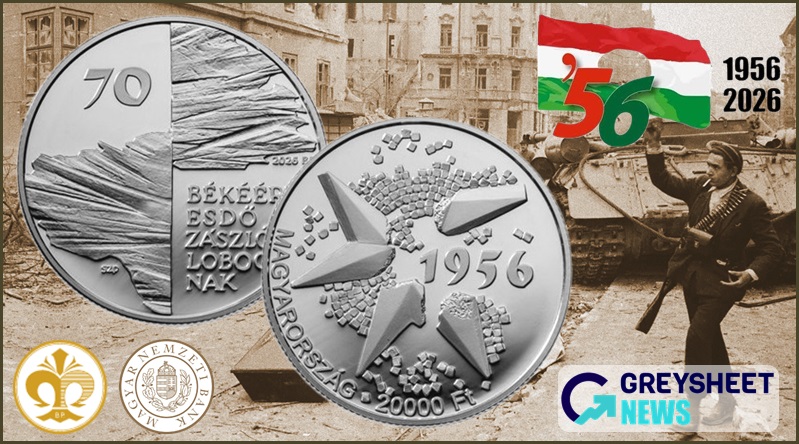
The coins are produced by the Mint of Hungary at their facilities in Budapest on behalf of the National Bank and designed by artisan Peter Szanyi. The obverse features a five-pointed star broken into pieces and on the ground of cobblestones, it was the communist star along with the crest representing the socialist republic which was cut out of the Hungarian flag during the protests. The year 1956 is positioned between the star points on the right. Along the lower rim below the primary design is the text MAGYARORSZÁG • 20000 Ft. The reverse of the coin depicts a flag with tattered and torn edges, to the left of the representation of the flag, near the upper edge is the numeral 70 referring to the 70th anniversary of the 1956 Revolution and War of Independence. To the right and near the lower right edge is a five-line excerpt from László Nagy's poem Pearl Skirt, written in 1953 and which reads BÉKÉÉRT ESDŐ ZÁSZLÓK LOBOGNAK ( Flags fluttering begging for peace) Just below the portion of flag on the lower right is the year of issue, 2026 and the mintmark BP denoting the Budapest Mint.
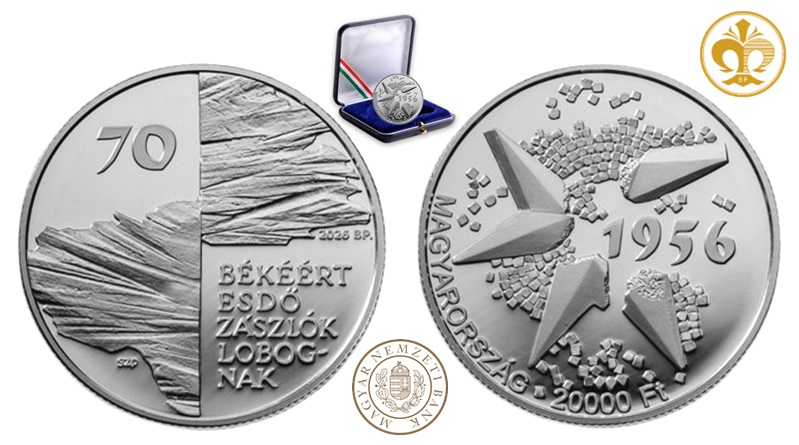
| Denomination | Metal | Weight | Diameter | Quality | Mintage Limit |
| 20000 Forint | .925 Silver | 31.4 g. | 38.6 mm. | Proof | 5,000 |
This coin is only available in silver and is the first such coin since 2014 where a base metal version is not planned. Each silver Proof coin is encapsulated and accompanied with a certificate of authenticity. Collectors in Hungary or visiting can purchase the coins from the Hungarian Mint’s retail shop. For additional information, visit the e-webshop of the Hungarian Mint.
United Kingdom - Royal Mint
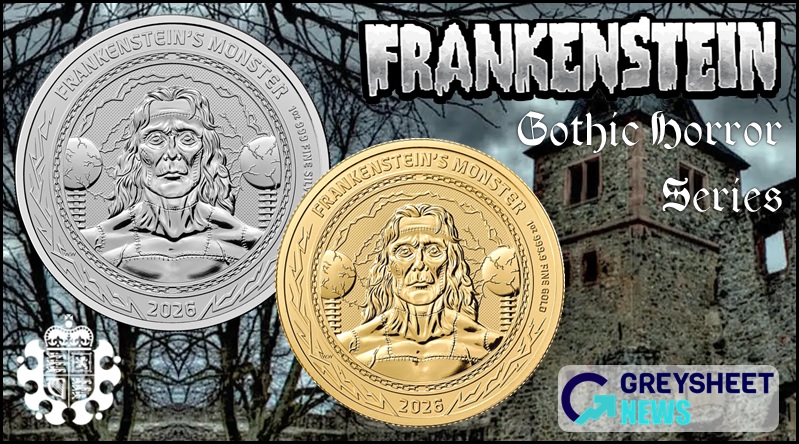
Bullion Gold and Silver Coins Feature Frightening Likeness of Frankenstein
Mary Shelley's Frankenstein is widely regarded as a seminal work of Gothic fiction. It’s terrifying yet tragic monster and tortured mad scientist remains one of the most recognisable figures in literary fiction. As part of the Gothic Horror bullion series launched last year, another ghoulish character is featured just in time for when things go bump in the night.
The legacy of the Frankenstein monster began on a stormy night in 1816, when a group of friends gathered at a villa on the shores of Lake Geneva to tell each other ghost stories. The company, including the poets Lord Byron and Percy Shelley, who had been discussing the latest scientific controversy – was human life simply biological or did it contain ‘the divine spark’ of God? That night, Mary Godwin, who would later be known as Mary Shelley after her marriage to Percy, experienced a fevered dream about the birth of a terrible creature that would become the catalyst to the creature we know today as Frankenstein.
Initially, her anonymously published novel in 1818 was entitled Frankenstein, or The Modern Prometheus. Shelly’s name would eventually appear on the second edition which was published in France in 1823.
This isn’t the first time the compassionate but frightening creature was included on British coinage. In 2018, the Royal Mint marked the 200th anniversary of the publication of Mary Shelly’s Frankenstein novel with the release of £2 commemorative coins.
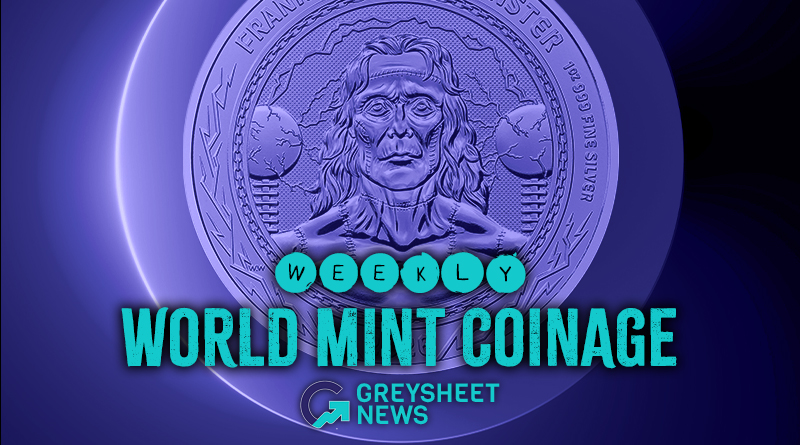
Designed by William Webb, the reverse depicts a frontal portrait of Frankenstein's monster in detail with the stitches visible where he was pieced together. The image is shared with motifs inspired by the novel such as the electrodes and lightning bolts generated to bring the monster to life. The design is surrounded by both a ring of chain links and electricity waves to the lower half and the text FRANKENSTEIN’S MONSTER placed above along the rim. Along the right rim are the coin’s specifications and below the primary design is the year of issue, 2026. An enhanced security feature includes microdots in the background field. The obverse of both gold and silver coins features the definitive effigy of King Charles III designed by Martin Jennings. The denomination 100 POUNDS (gold) or 2 POUNDS (silver) is included as part of the legend surrounding the King’s likeness. The field behind the effigy utilises a radiant, light-refracting background texture.
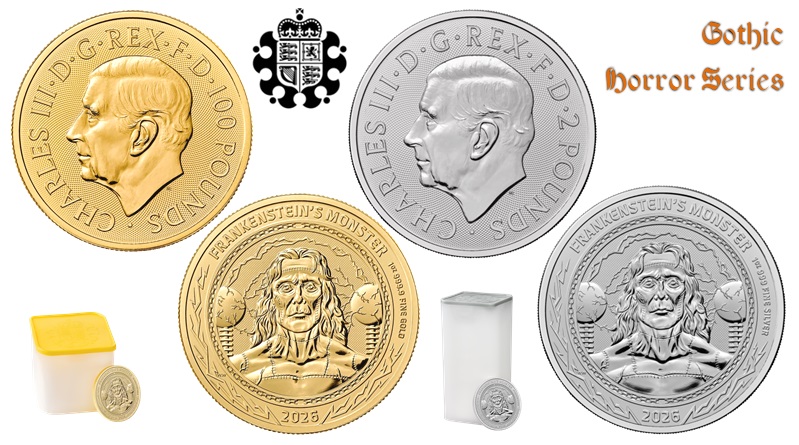
| Denomination | Metal | Weight | Diameter | Quality | Mintage |
| 2 Pounds | .999 Silver | 31.2 g. | 38.6 mm. | Bullion | 30,000 |
| 100 Pounds | 999.9 Gold | 31.21 g. | 32.6 mm. | Bullion | 4,000 |
Each option is individually encapsulated and available from Royal Mint Bullion or selected bullion dealers in partnership with the Royal Mint. The silver coins are available in consignments containing up to 500 pieces or tubes of 25 pieces. The gold coins are also available in consignments of 25 pieces in storage tubes. For additional information, visit the investment website of the Royal Mint.
Related Stories (powered by Greysheet News)
View all news
New coins from Australia, China, and the Netherlands.

New coins from the Falkland Islands, Gibraltar, and Malta.
Please sign in or register to leave a comment.
Your identity will be restricted to first name/last initial, or a user ID you create.
Comment
Comments