




 Whitman Expo
Weekly World Mint Coinage: October 15, 2026
New coins from France, Italy, and Spain.
by Michael Alexander |
Published on October 15, 2026


Download the Greysheet app for access to pricing, news, events and your subscriptions.

Subscribe to RQ: Red Book Quarterly for the industry's most respected pricing and to read more articles just like this.
France - Monnaie de Paris
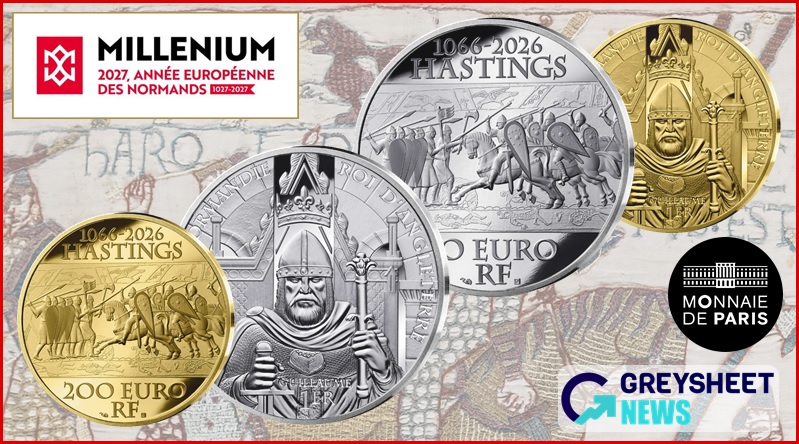
Gold and Silver Proof Coins Mark Decisive Medieval Battle of Hastings
The year 2026 celebrates the 960th anniversary of the Battle of Hastings, an event that is marked by both Great Britain and France as a decisive victory for William the Conqueror over the Anglo-Saxon armies in Britain. The victory brought an end to Anglo-Saxon rule and paved the way for the Norman conquest of England. The Battle of Hastings permanently transformed the political and cultural history of the kingdom. Nearly a thousand years later, this founding event remains a major symbol of European history.
William I (1028 – 1087) was the illegitimate and only son of Robert I, Duke of Normandy. Despite his circumstances of birth, William was named his father’s heir and succeeded to the title of duke in 1035. William’s claim to the English throne stemmed from his assertion that the childless King Edward the Confessor had promised him the crown in 1051 during the years he had spent in exile in Normandy. However, when Edward the Confessor died in January 1066, the Witenagemot - the English council of nobles chose Harold Godwinson as king and as such, Harold took the crown for himself, breaking his oath to William.
William refused to accept this and viewed Harold as an illegal ruler. With this in mind, William crossed the English Channel. King Harold, hearing of the landing of William and his armies, departed for Hastings, mustering whatever troops he could. The battle began on the 14th October 1066. King Harold was killed during the battle, allegedly from an arrow which struck him in the eye and launched by a Norman soldier. With their king dead, the English line collapsed.
William was crowned King of England and recognised as the first King of the House of Normandy. King William I – also known as ‘the conqueror’ died on the 9th September 1087, from severe internal injuries after an accident on his horse, he was 58 years old.
The gold and silver Proof coins are designed by the chief engraver of the Monnaie de Paris, Joaquin Jimenez, who has taken a very unique approach to the portrait of William I. The obverse shared on both gold and silver features a front-facing image of the Duke of Normandy, known as ‘the Conqueror’, about to be crowned as William I, King of England. Seated on the throne of Edward the Confessor in Westminster Abbey, William holds in his left hand a sceptre, symbol of royal power. Along the upper left rim is the inscription DUC DE NORMANDIE and along the upper right, ROI D’ANGLETERRE. Just under William’s image is his name GUILLAUME 1ER. The reverse recreates a key scene from the Bayeux Tapestry, in which Norman horsemen charge the English infantry on the Sussex hills at Hastings. The success of this offensive was decisive in the Normans’ victory in the conquest of England. Above the primary design is the text 1066 – 2026 HASTINGS and below, the denomination 200 EURO (gold) or 10 EURO (silver) along with the initials RF representing Republique Francaise.
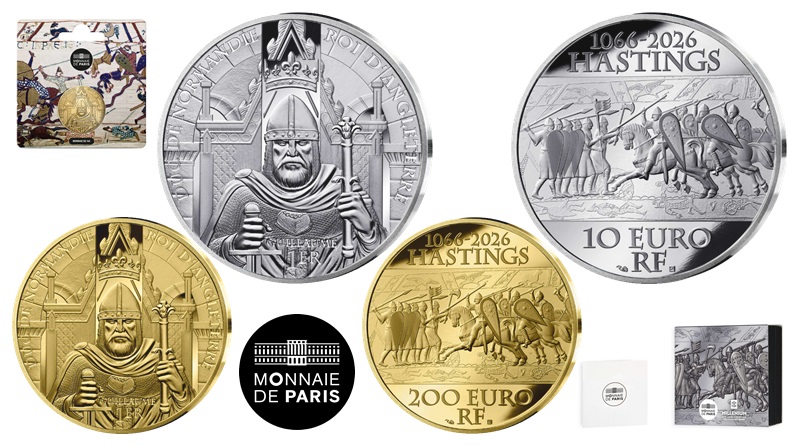
| Denomination | Metal | Weight | Diameter | Quality | Mintage Limit |
| ¼ Euro | Base Metal | 15.8 gr. | 34 mm. | UNC | 10,000 |
| 10 Euro | .999 Silver | 22.2 g. | 37 mm. | Proof | 5,000 |
| 20 Euro | .999 Gold | 3.11 g. | 15 mm. | Proof | 1,000 |
| 50 Euro | .999 Gold | 7.78 g. | 22.2 mm. | Proof | 1,000 |
| 200 Euro | .999 Gold | 31.1 g. | 37 mm. | Proof | 250 |
The base metal UNC coins are presented in a sealed coin-card format with specifications included on the packaging. The gold and silver Proof quality coins are encapsulated and presented in a custom case accompanied with a certificate of authenticity. For additional information, visit the e-webshop of the Monnaie de Paris.
Italy - Istituto Poligrafico e Zecca dello Stato
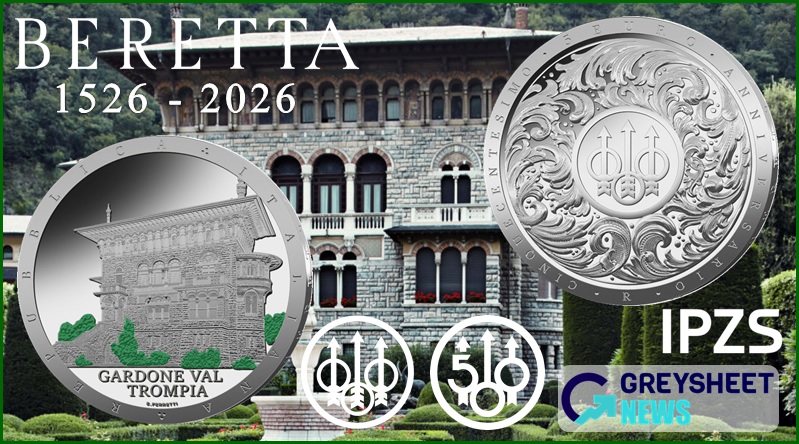
Silver Proof Coins Mark Quincentenary of the Founding of the Beretta Arms Factory
The Fabbrica d'Armi Pietro Beretta S.p.A. is an Italian firearms manufacturing company widely recognised as the oldest active firearm manufacturer in the world and one of the oldest continuously operating family businesses. Documented as active in Gardone Val Trompia since 1526, the company has been run by the Beretta family for 15 successive generations.
Built into a steep valley, the facility comprises unique architectural features, including modern machinery bays, live plant installations to optimise workplace air quality, and an underground network of secret tunnels connecting different areas. Also noteworthy is the historic Beretta Villa, whose origins are the result of a remarkable act of corporate philanthropy. Following the end of the WWI, the demand for military firearms plummeted, leaving the factory with severely reduced production levels. Rather than seeing his surplus workforce lose their jobs, company patriarch Pietro Beretta teamed up with renowned Brescian architect Egidio Dabbeni to build a grand family villa entirely on the factory complex, employing manufacturing floor employees who otherwise would have faced unemployment. The striking, four-story stone mansion situated directly on the Beretta Factory grounds in Gardone Val Trompia was completed in 1925.
Today, the Fabbrica d'Armi Pietro Beretta factory produces approximately 1,200 guns daily and employs around 900 people. While famous globally for military and law enforcement sidearms such as the Beretta 92FS, they also produce sporting and hunting arms which account for three-quarters of total sales. The Fabbrica d'Armi Pietro Beretta insignia consisting of three arrows striking the same number of circles has been the company's official logo since 1949. For 2026, on the occasion of the quincentenary anniversary, it was re-designed to incorporate the numeral 500.
Designed by Emanuele Ferretti, the obverse features the historic and distinctive Beretta Villa headquarters positioned in the centre. The landscape and shrubbery is accented with green colour. Below the villa is the text GARDONE VAL TROMPIA the name of the town where the company is based. Surrounding the primary design is a wide flat rim with the incused text REPUBBLICA ITALIANA. The reverse features the official Beretta logo comprising arrows and circles which is centred and surrounded by a filigree wreath decoration. The design is surrounded by a wide flat rim with incused lettering that includes the denomination 5 EURO and commemorative inscription CINQUECENTESIMO ANNIVERSARIO. The mintmark R denoting the Rome Mint is shown below on the rim. The edge of the coin includes raised lettering which reads .˙. 1526 · : BERETTA :· 2026
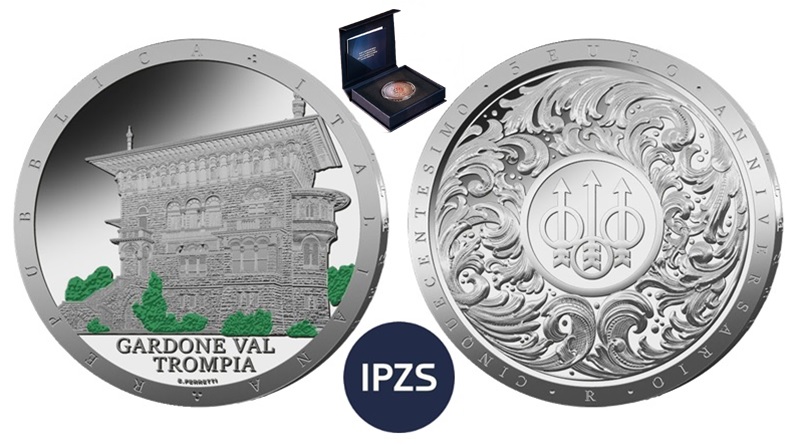
| Denomination | Metal | Weight | Diameter | Quality | Maximum Mintage |
| 5 Euro | .999 Silver | 31.7 g. | 37.2 mm. | Proof & Colour | 7,000 |
Each Proof and colour silver coin is encapsulated and presented in a heavy gauge, lined card case accompanied by a certificate of authenticity. For additional information, visit the e-webshop of the Istituto Poligrafico e Zecca dello Stato – IPZS.
Spain - Fábrica Nacional de Moneda y Timbre – Real Casa de la Moneda

Gold Ounce Bullion Coin Series Continues With Iberian Pig
Spain’s Real Casa de la Moneda offers the sixth design in the gold one-ounce bullion series dedicated to the animals of the Iberian Peninsula. This series began in 2021 featuring some of the most representative animals of Iberian fauna, perfectly combining tradition, identity and Spanish numismatics.
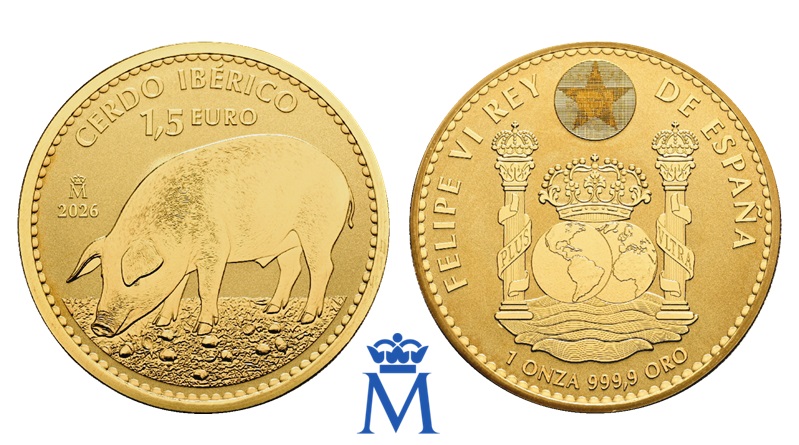
For 2026, the topic featured is the Iberian pig. With more than 80 different recognised breeds of swine around the globe, this particular one is an integral part of the culture and landscape of the Iberian Peninsula, especially the dehesas - pasturelands of the southwest. The Iberian pig is a traditional, heritage breed native to the Mediterranean basin and exclusive to the Iberian Peninsula including both Spain and Portugal. They still roam free in the unique oak-and-grass woodland ecosystem in southwestern Spain and southern Portugal. As they are biologically prone to storing high amounts of intramuscular and epidermal fat, this results in their meat’s signature marbling, smooth texture and rich flavour. Iberian pigs have a slender, elongated body, sparse dark hair, a long snout and long, strong legs that typically feature dark or black hooves, leading to their well-known nickname pata negra meaning black leg.
The reverse features an image of an Iberian pig in its natural habitat. Along the upper rim is the inscription CERDO IBÉRICO (Iberian Pig) and just below, the denomination 1,5 EURO. The mintmark of the Real Casa de la Moneda, a crowned M along with the year of issue, 2026 is placed just to the left of the primary design. The entire design is surrounded by a pine cone border which is a characteristic of this entire collection. The obverse depicts the classic motif of the Columnario, the familiar design seen on the historic Spanish Pillar Dollar silver coins once recognised worldwide as the primary coin of international trade. The crest depicts two hemispheres under a royal crown, flanked by the Pillars of Hercules with the motto PLUS VLTRA (further beyond), above a sea of waves. The addition of a unique security measure patented by the Fábrica Nacional de Moneda y Timbre - Real Casa de la Moneda and placed above the crest is the quadruple latent image security feature when tilted under a source of light, enables four different images to be viewed such as the mintmark, a five-pointed star, the euro currency symbol and the silhouette of the columnar. The legend seen to the left and right edge reads FELIPE VI REY DE ESPANA along with the specifications 1 ONZA 999,9 ORO seen below the crest. The coin is struck in reverse Proof quality with the background shown in matte and the engraved relief with a polished effect.
| Denomination | Metal | Weight | Diameter | Quality | Maximum Mintage |
| €1.50 | 999.9 Gold | 31.1 g. | 37.2 mm. | Reverse-Proof effect | 5,000 |
Each coin is individually encapsulated and available through a network of official bullion distribution partners of the Real Casa de la Moneda. For additional information, visit the e-webshop of the Real Casa de la Moneda or consult your nearest gold bullion dealer.
Related Stories (powered by Greysheet News)
View all news
New coins from Canada, Ireland, and the United Kingdom.



New coins from Austria, Germany, and Switzerland.
Please sign in or register to leave a comment.
Your identity will be restricted to first name/last initial, or a user ID you create.
Comment
Comments