


 Whitman Expo
November 2026 Greensheet Market Analysis: Heritage Sale Keeps Market Moving
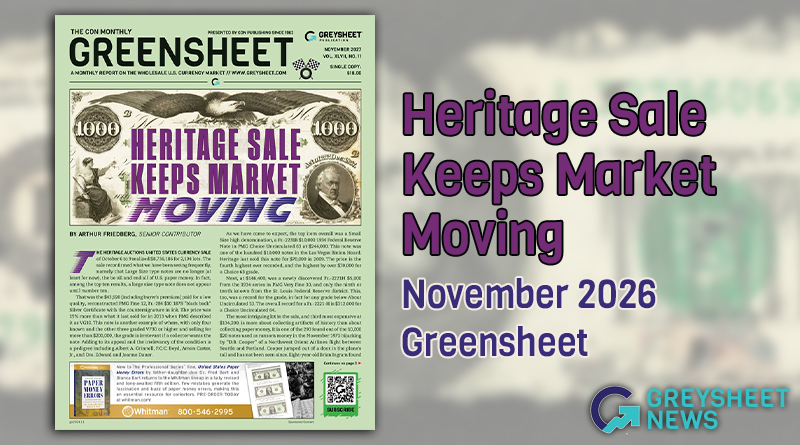
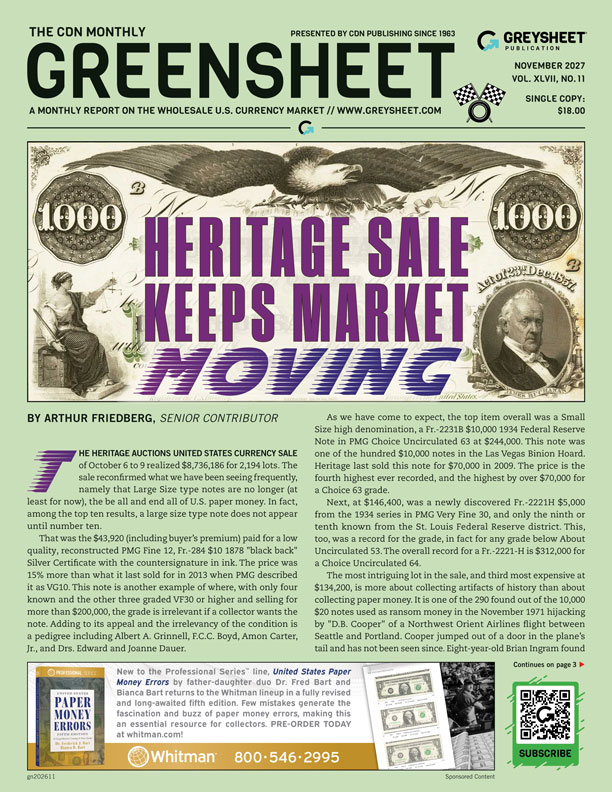
The Heritage Auctions United States currency sale of October 6 to 9 realized $8,736,186 for 2,194 lots.
by Arthur Friedberg |
Published on November 3, 2026

Download the Greysheet app for access to pricing, news, events and your subscriptions.
Subscribe to Greensheet for the industry's most respected pricing and to read more articles just like this.
The sale reconfirmed what we have been seeing frequently, namely that Large Size type notes are no longer (at least for now), the be all and end all of U.S. paper money. In fact, among the top ten results, a large size type note does not appear until number ten.
That was the $43,920 (including buyer’s premium) paid for a low quality, reconstructed PMG Fine 12, Fr.-284 $10 1878 "black back" Silver Certificate with the countersignature in ink. The price was 15% more than what it last sold for in 2013 when PMG described it as VG10. This note is another example of where, with only four known and the other three graded VF30 or higher and selling for more than $200,000, the grade is irrelevant if a collector wants the note. Adding to its appeal and the irrelevancy of the condition is a pedigree including Albert A. Grinnell, F.C.C. Boyd, Amon Carter, Jr., and Drs. Edward and Joanne Dauer.
As we have come to expect, the top item overall was a Small Size high denomination, a Fr.-2231B $10,000 1934 Federal Reserve Note in PMG Choice Uncirculated 63 at $244,000. This note was one of the hundred $10,000 notes in the Las Vegas Binion Hoard. Heritage last sold this note for $70,000 in 2009. The price is the fourth highest ever recorded, and the highest by over $70,000 for a Choice 63 grade.
Next, at $146,400, was a newly discovered Fr.-2221H $5,000 from the 1934 series in PMG Very Fine 30, and only the ninth or tenth known from the St. Louis Federal Reserve district. This, too, was a record for the grade, in fact for any grade below About Uncirculated 53. The overall record for a Fr.-2221-H is $312,000 for a Choice Uncirculated 64.
The most intriguing lot in the sale, and third most expensive at $134,200, is more about collecting artifacts of history than about collecting paper money. It is one of the 290 found out of the 10,000 $20 notes used as ransom money in the November 1971 hijacking by "D.B. Cooper" of a Northwest Orient Airlines flight between Seattle and Portland. Cooper jumped out of a door in the plane’s tail and has not been seen since. Eight-year-old Brian Ingram found the 290 notes in three packs on the shoreline of Washington’s Columbia River in February 1980. They were badly decomposed but still held together by rubber bands. After the FBI confirmed what they were, except for fourteen kept by the bureau, they were split between Ingram and the airline’s insurance company. (The original $200,000 was drawn from the airline’s account at the Seattle First National Bank.) PCGS Banknote certified the remnant as "Genuine." Assigning a number would have been ridiculous. Heritage described the note as bigger and better than most, having both serial numbers, Jackson's portrait, Treasury and District L (for San Francisco) seals, the series, obligation clause, and Secretary of the Treasury David M. Kennedy's printed signature. At 4.5 inches x 1.5 inches, it is one of the two largest Heritage has ever offered. No other Cooper relic has realized more than $20,400 at Heritage.
The Texas State Historical Association describes DeWitt's Colony as one of the major colonies in the settlement of Texas. It was established near Austin by Green DeWitt and James Kerr in 1825. To encourage settlement along its northern border, Mexico awarded empresario (land agent or land contractor) contracts, such as the one to DeWitt on April 15, 1825. The only known example of an empresario note, i.e., land scrip, with a handwritten $2 value and serial number 2, severed, reattached, and restored, sold for $79,300. The text reads "This Bill will be received as a Cash payment for Twenty Dollars on account of fees for land in DeWitts Colony." It is dated October 15, 1825. The currency was transferable and was used as a medium of exchange, but the venture was a failure.
Four large size National Bank Notes broke $40,000: A $50 1902 Red Seal (Fr.-665) issued by The First National Bank of Portland, Oregon in PMG VF25, just one of four $50 Red Seals from the state, ($51,240); an EF45 $5 1875 (Fr.-404) of The First National Bank of Pensacola, Florida, and the finest of the four First Charter notes reported for the entire state ($48,800); a serial number 1 $20 1882 Brown Back (Fr.-494) from The Consolidated National Bank of San Diego in PMG EF 40 ($46,360); and unique for the bank and city, a $20 1902 Date Back (Fr.-645) of The First National Bank of Maricopa, California graded PMG VF25 EPQ ($41,480).
One of two known uncut pairs of the Fr.-1373a 50¢ Third Issue Justice fractional currency issue brought $48,800 in PMG Choice AU58 EPQ. This was less than comparable results from 2024 and 2025, but consistent with the current fractional currency market. Only nine examples of Fr.-1373a are known—the two pairs and five single notes.

Related Stories (powered by Greysheet News)
View all news
We now have the first prices realized dataset for the immense Stack's Bowers Global Showcase auction, and it reveals a market that is moving in two directions at the same time.

It is possible that an American woman will now appear on a European banknote before one from the United States.
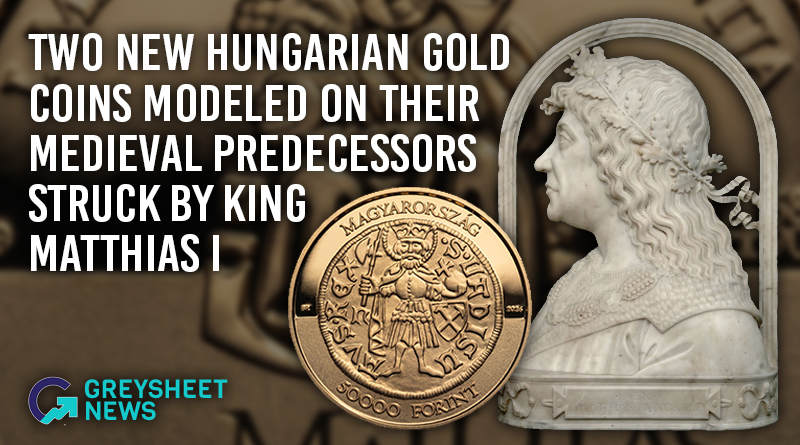
In 2026, The Hungarian Mint is issuing a gold collector coin called “The Gold Florin of Matthias I”, in single-ducat weight and quadruple-ducat weight (piedfort) versions, as well as a base metal version in a copper-nickel-zinc alloy.
Please sign in or register to leave a comment.
Your identity will be restricted to first name/last initial, or a user ID you create.
Comment
Comments